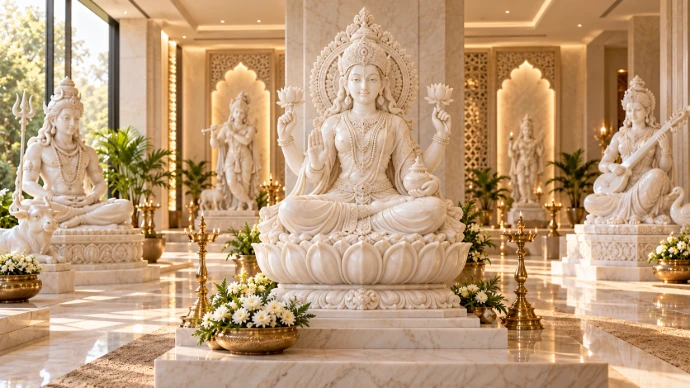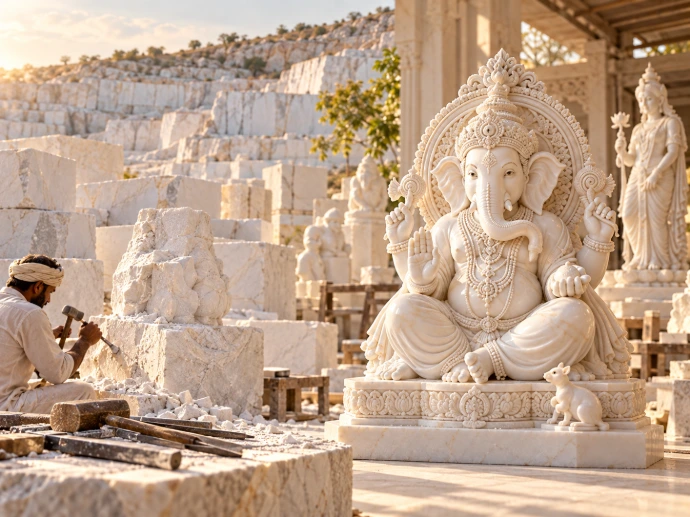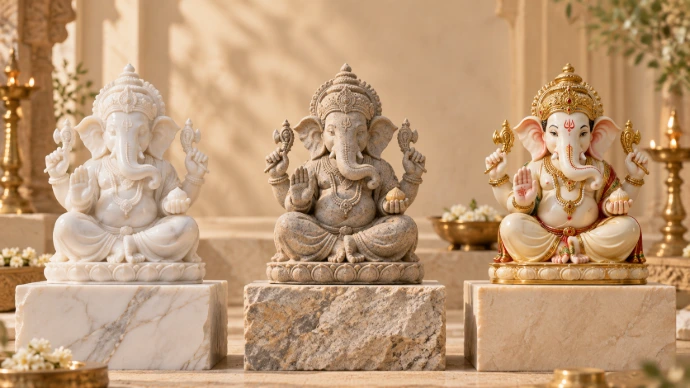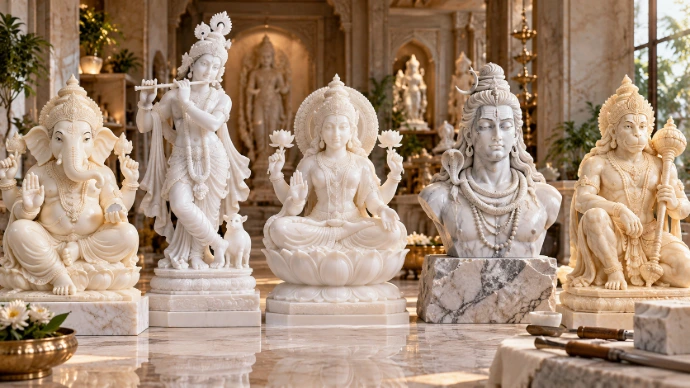
A marble idol is more than a decorative object. In Hindu traditions, the making of a murti brings together material, proportion, iconography and the skill of the sculptor. The stone must suit the intended form, whether it is a serene Buddha, an intricately ornamented Lakshmi, a Jain Tirthankara or a deity destined for a home mandir.
But which marble is best for making idols: Makrana, Vietnam, Ambaji, Rajnagar or Morwad?
Each name represents a different sourcing tradition and commercial offering. Makrana is associated with India's historic marble architecture, while Vietnamese white marble is often chosen for its bright appearance. Ambaji, Rajnagar and Morwad are established names in the Indian marble trade, but their suitability for sculpting depends on the particular block, its mineral characteristics and the finish required.
The best choice is therefore not simply the whitest or most expensive stone. It is the marble that combines suitable physical properties, reliable sourcing, appropriate aesthetics and the right carving quality for the project.
This guide compares all five options to help homeowners, temple committees, architects and institutional buyers make a more informed decision.
A Quick Overview of the Five Marbles
An important distinction: These are sourcing and trade categories, not five precisely standardised engineering grades. Colour, hardness, porosity and strength can vary within a single quarry or commercial variety. A marble's regional name alone cannot establish its performance.
For a valuable or large commission, request a sample, inspect the actual block and discuss technical suitability with the sculptor before making a final decision.
| Marble Type | Origin | What to Consider for Idols | General Buying Position |
|---|---|---|---|
| Makrana marble | Rajasthan, India | Historic reputation, natural white tones and suitability for detailed carving when the block is sound | Often positioned as a premium option |
| Vietnam marble | Vietnam | Bright white appearance, block consistency and suitability for clean, contemporary finishes | Depends on grade, import costs and supplier |
| Ambaji white marble | Banaskantha region, Gujarat, India | Actual whiteness, surface markings, block integrity and sculpting performance | Grade- and supplier-dependent |
| Rajnagar marble | Rajsamand region, Rajasthan, India | Colour variation, grain, veining and the quality of the selected block | Grade- and supplier-dependent |
| Morwad marble | Rajasthan, India | Visual consistency, natural markings, carving response and availability in suitable blocks | Grade- and supplier-dependent |
Makrana Marble: The Historic Benchmark for Marble Idols
Makrana marble, quarried in Rajasthan, occupies a distinctive place in India's architectural and sculptural history. It is famously associated with the Taj Mahal, whose luminous white surfaces demonstrate how marble can respond to daylight, shadow and changing atmospheric conditions.
Its appeal extends beyond architecture. For religious sculpture, white marble can create a restrained visual field in which the face, hands, ornaments and symbolic attributes of a deity become the focus.
What makes Makrana marble worth considering? Makrana marble is valued for its natural white appearance, range of tonal variations and established use in architectural and sculptural work. Its reputation is also associated with relatively low water absorption in suitable material, although actual performance depends on the specific variety and block.
For idol-making, the important question is whether the chosen block can retain fine details without developing cracks, weak edges or unwanted breakage during carving.
Makrana can be a compelling option for:
- Traditional Hindu deity statues with detailed jewellery and ornamentation.
- Jain Tirthankara murtis that require calm expressions and carefully controlled proportions.
- Large temple commissions where the material's provenance and visual character matter.
- Heirloom pieces intended to remain part of a family or institution for generations.
Does Makrana marble always have to be the best? No. Its heritage and reputation do not automatically make every Makrana block superior to every alternative. Natural inclusions, fissures, colour variation and block dimensions still matter.
Nor should all Makrana marble be described as perfectly white. Different varieties can display subtle tonal differences and natural markings.
Practical verdict: Choose Makrana when its specific appearance, provenance and carving characteristics meet the brief, particularly for a traditional or premium commission. Evaluate the actual block rather than buying on reputation alone.
For a deeper exploration, read The Timeless Beauty of Makrana Marble.
Vietnam Marble: A Modern Alternative for Bright White Idols
Vietnamese white marble has attracted attention among buyers looking for a bright, clean aesthetic. Depending on the grade and supplier, it can offer a relatively uniform white appearance that suits contemporary interiors, minimalist mandirs and sculptures where the purity of the silhouette is central to the design.
Its popularity should not be confused with a universal technical specification. Vietnamese marble comes from different deposits and is sold in different grades. The characteristics of one imported consignment cannot safely be applied to every block sold under the name.
Why consider Vietnam marble for a murti? A bright, relatively consistent stone can help maintain visual clarity across a statue's face, limbs, clothing and larger sculptural planes. It may be attractive for modern interpretations of traditional forms, especially where the buyer prefers a cleaner surface with limited visible markings.
Before selecting Vietnam marble, ask about:
- The precise quarry or commercial grade.
- Natural fissures, filled cracks or resin treatment, if any.
- The dimensions and integrity of the available block.
- The sculptor's experience working with that particular material.
- Import-related lead times, replacement availability and transport costs.
Vietnamese marble is sometimes marketed as lighter than Indian alternatives. However, weight depends primarily on density and the finished dimensions of the statue, not on the country of origin alone. Compare actual density data and calculate the finished sculpture's estimated weight before making structural or installation decisions.
Is Vietnam marble better than Makrana? Not inherently. Vietnam marble may suit buyers who prioritise a particular bright-white appearance, while Makrana may appeal to those who value its Indian heritage and established architectural associations. The better material is the one that performs well for the intended design, budget and setting.
Practical verdict: Consider Vietnam marble when a bright, contemporary look is important and the supplier can document the grade, block quality and logistics.
For more detail, see Vietnam Marble: The Modern Choice.
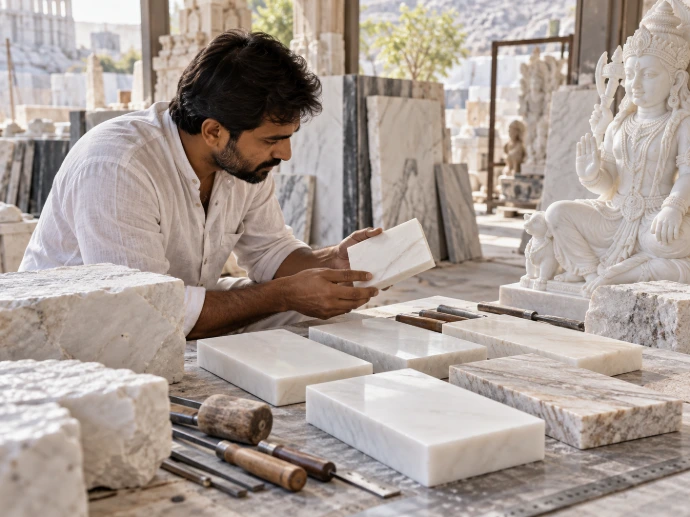
Ambaji White Marble: Understanding the Gujarat Option
Ambaji marble is associated with the Ambaji region of Banaskantha district, Gujarat, an area known for its religious and architectural significance. The name also has strong cultural resonance because Ambaji is an important Shakti pilgrimage destination.
For buyers searching for Ambaji white marble, the central question is whether the particular material available offers the desired colour, surface character and carving performance.
What should buyers know about Ambaji marble? White marble is not a single uniform product. Commercially available Ambaji material can differ in tone, markings, block size and finish. Claims about its whiteness, hardness or water absorption should therefore be tied to a specific grade or tested sample rather than assumed from the name.
For idol-making, inspect the stone under both natural and indoor lighting. A sample that appears bright under a showroom's artificial lights may look different in a home mandir or temple with warmer illumination.
Pay particular attention to:
- Colour and consistency: Is the tone suitable for the deity and the surrounding architecture?
- Veining and markings: Will natural lines complement the design or interrupt important facial and ornamental details?
- Block integrity: Are there visible fissures, weak corners or repairs?
- Carving response: Can the material hold the required facial features, fingers, jewellery and other fine details?
- Availability: Can a matching block be sourced if the project requires multiple statues or future additions?
Is Ambaji white marble suitable for idols? It can be, provided the selected grade is appropriate for the sculptural requirements. However, a reliable comparison with Makrana or Vietnam marble requires actual block samples and, where durability is critical, comparable test results.
Practical verdict: Ambaji marble deserves consideration when its available grade meets the project's visual and technical requirements. Ask the supplier to identify the exact material being offered rather than relying on the regional name alone.
For buyers comparing Ambaji white marble price, remember that the final cost includes more than the raw stone. Block quality, carving complexity, polishing, wastage, transport and installation can all influence the finished statue's price.
Rajnagar Marble: A Rajsamand-Belt Option
Rajnagar is associated with Rajasthan's broader Rajsamand marble belt. In commercial searches, the term Rajsamand marble may be more familiar than Rajnagar marble, making both names useful when researching regional sourcing options.
For a sculptor, the decisive issue is not simply where the stone was quarried. It is how the individual block behaves when shaped into a three-dimensional form.
What should you look for in Rajnagar marble? Regional marble supplies can include variations in background colour, natural markings, grain structure and block quality. These features may be perfectly acceptable for flooring or architectural surfaces but less suitable for a sculpture requiring uninterrupted detail across the face or hands.
A statue places different demands on stone than a flat slab. Thin projections, fingers, crowns, weapons, halos and decorative edges can be vulnerable if the block contains unfavourably oriented fissures.
When considering Rajnagar or Rajsamand marble, ask the supplier and sculptor to assess:
- Whether the selected block is free from significant open fractures.
- Whether its colour and markings are consistent with the approved design.
- Whether it is suitable for the statue's scale and level of ornamentation.
- Whether a test carving or sample finish is possible.
- Whether the same grade can be sourced consistently for a multi-statue project.
How does Rajnagar compare with Makrana? There is no sound basis for declaring either universally stronger or more durable simply from the regional name. A technically sound Rajnagar block may be more suitable than a flawed block from a better-known source. Conversely, a project requiring a specific white tone or documented performance may favour another material after sampling and testing.
Practical verdict: Rajnagar marble is worth evaluating as a regional sourcing option, especially when a supplier can provide a suitable block and the sculptor confirms its workability. Treat Rajnagar marble and Rajsamand marble as useful search terms, but confirm the actual origin and grade with the seller.
Morwad Marble: A Distinct Option in Rajasthan's Marble Trade
Morwad marble is another established name in Rajasthan's marble market. Interest in Morwad marble, Morwad white marble and Morwad marble price reflects buyers' desire to compare regional varieties before committing to a project.
However, a popular trade name does not guarantee a uniform appearance or a standard set of physical properties. The particular grade and block should always guide the decision.
What makes Morwad marble worth comparing? Morwad marble may be considered for projects where a suitable colour, finish, block size and overall cost can be sourced. Whether it is the right choice for a finely detailed idol depends on the material's actual characteristics, not just its suitability for slabs or flooring.
A practical assessment should cover three areas.
1. Visual character
Examine the stone's background tone, natural veins and consistency. For a white deity statue, even subtle colour differences can influence the finished appearance, especially when multiple figures are placed together.
2. Sculptural workability
The sculptor should assess whether the stone can retain the required contours and small details. A material that performs well for a broad architectural surface may behave differently when carved into delicate ornaments or projecting features.
3. Total project cost
Compare the cost of the stone and the cost of turning it into a finished statue. A lower-priced block may contain more defects or require greater wastage. A higher-priced block may not justify its premium if its appearance and performance do not add value to the specific project.
Morwad marble vs Makrana marble: Which should you choose? Neither name is enough to settle the comparison. Makrana has a widely recognised heritage and premium positioning, while the relative value of Morwad depends on the grade offered, local availability, block quality and the work required.
Request comparable samples, examine them under the same lighting and obtain a quotation for the same statue design. That provides a more meaningful comparison than comparing raw-stone prices alone.
Practical verdict: Morwad marble can be a practical candidate when its actual block quality, finish and total project cost align with the commission. Confirm the grade's suitability with the sculptor before ordering.
Choosing the Right Marble with Shilakrut
Whichever marble you are considering, the final result depends on far more than the regional name attached to the stone. Block quality, grade, sculptural workability and the sculptor's skill all shape the finished idol.
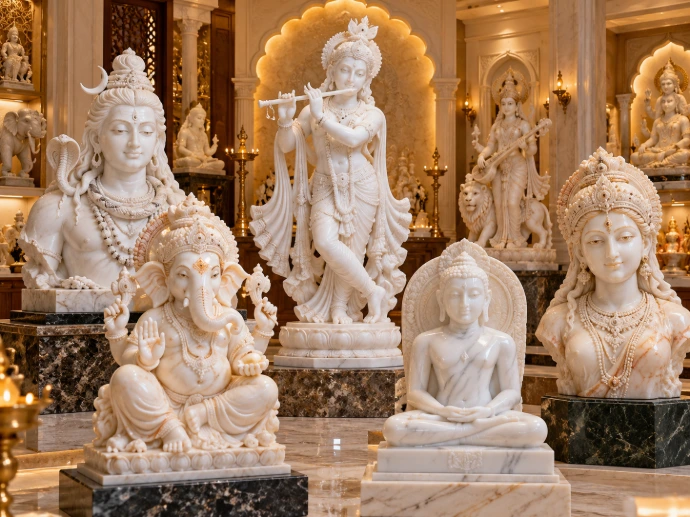
Shilakrut's artisans work closely with clients to identify the right material and finish for each commission, whether the brief calls for a traditional Makrana deity, a bright contemporary Vietnam marble piece, or a carefully sampled Ambaji, Rajnagar or Morwad block suited to the design.
Speak with Shilakrut's team to discuss which marble is right for your next idol or temple project.
Frequently Asked Questions
Neither is universally better. Makrana offers historic Indian heritage and established use in sculpture, while Vietnam marble offers a bright, consistent white appearance popular for contemporary designs. The right choice depends on the actual block quality, budget and intended aesthetic.
It can be, but quality varies by grade and supplier. Inspect colour, veining, block integrity and carving response under both natural and indoor lighting before deciding.
Rajnagar marble is associated with Rajasthan's Rajsamand marble belt and is commonly searched under both "Rajnagar marble" and "Rajsamand marble". Its suitability for idols depends on the specific block's colour, grain and freedom from fractures.
Neither name alone settles the comparison. Makrana carries greater heritage and premium positioning, while Morwad's value depends on the grade, block quality and cost offered for a specific project. Compare actual samples before deciding.
Pricing for Ambaji, Rajnagar and Morwad marble is generally grade- and supplier-dependent, while Makrana is often positioned at a premium. Compare total project cost — including carving, polishing and wastage — rather than raw-stone price alone.
Yes, different marbles can be used for different elements of a project — for example, one marble for the main idol and another for flooring or architectural surfaces — provided the overall design and visual coherence are considered.
Makrana, Vietnam, Ambaji, Rajnagar and Morwad each bring their own history, aesthetic and trade position to the world of marble idol-making. None is automatically superior — the right choice depends on the specific block, its carving performance, and how well it serves the design, budget and setting of your project.
Speak with Shilakrut's artisans to sample, compare and select the marble best suited to your next idol or temple commission.