नमस्तस्यै नमस्तस्यै नमस्तस्यै नमो नमः ॥ To the Goddess who abides in all beings as Shakti, salutations again and again.
Shakti is one, even when the Mother appears in countless forms.
The 9 Forms of Navdurga: Names, Meaning & Day-Wise Significance
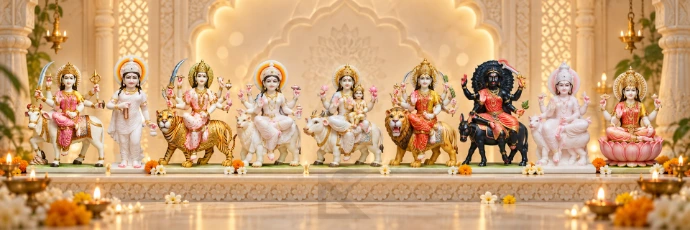
The following sequence is the commonly followed North Indian Navratri order. Regional and sectarian traditions can differ, and other nine-fold forms of Durga are found in older textual traditions.
| Navratri Day | Navdurga Form | Meaning of the Name | Symbolism / Significance |
|---|---|---|---|
| Day 1 | Shailaputri | Daughter of the Mountain | Stability, strength and a grounded beginning |
| Day 2 | Brahmacharini | The devoted ascetic / one who follows the path of Brahman | Tapas, devotion, patience and perseverance |
| Day 3 | Chandraghanta | She who bears the crescent moon like a bell | Courage, protection and readiness to confront evil |
| Day 4 | Kushmanda | The cosmic Mother associated with the cosmic egg | Creative energy, radiance and vitality |
| Day 5 | Skandamata | Mother of Skanda (Kartikeya) | Motherhood, compassion and protective strength |
| Day 6 | Katyayani | Goddess associated with Sage Katyayana | Warrior energy, courage and victory over Mahishasura |
| Day 7 | Kalaratri | The dark/fierce night of time | Fearlessness, destruction of darkness and protection |
| Day 8 | Mahagauri | The supremely radiant/pure one | Purification, serenity and renewal |
| Day 9 | Siddhidatri | Giver of siddhis or spiritual accomplishments | Fulfilment, wisdom and divine grace |
This day-wise sequence is documented in contemporary Navratri references and devotional traditions, while the deeper narratives surrounding individual forms draw from wider Puranic and Shakta traditions.
The Navratri Journey at a Glance
From rootedness → discipline → courage → creative energy → motherhood → warrior strength → confrontation with darkness → purification → fulfilment
This is best understood as a devotional interpretation, rather than a claim that every scripture explicitly defines the nine days as a linear spiritual progression.
Each Form in Detail: Story, Symbolism & What She Teaches
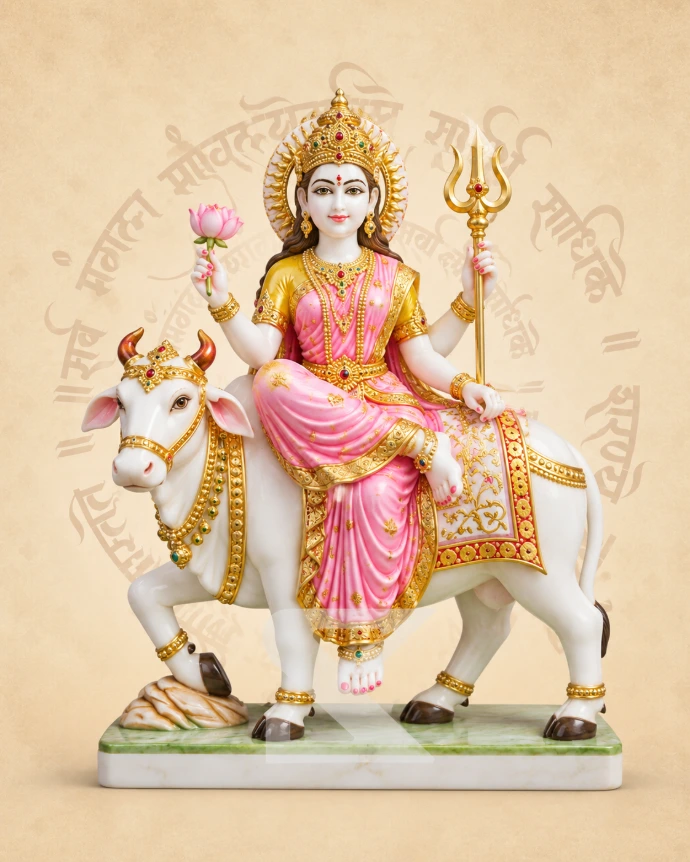
Navratri begins with Shailaputri, literally the "daughter of the mountain." In the popular Puranic narrative, she is associated with Parvati, the daughter of Himavan, following the story of Sati's previous birth.
She is traditionally depicted riding a bull and holding a trident and lotus. The mountain is an evocative symbol: immovable, patient and enduring.
Shailaputri therefore offers a beautiful beginning to Navratri. Before the seeker asks for victory or prosperity, there is a need for steadiness.
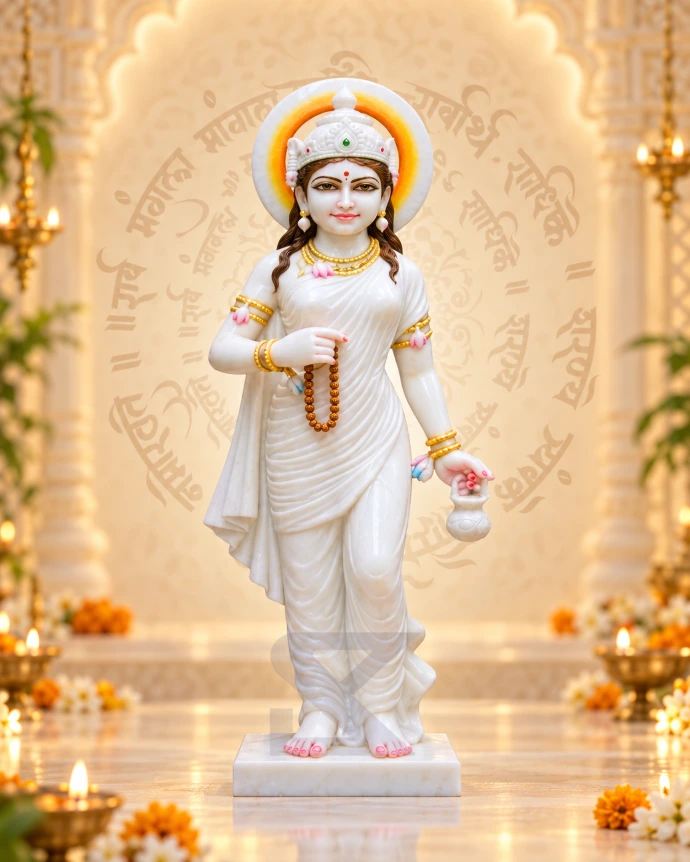
Brahmacharini represents Parvati in her unmarried, ascetic form. She is traditionally shown carrying a japa mala and kamandalu, symbols of prayer, discipline and austerity. The Navadurga tradition associates her with perseverance and tapas.
Her story recalls Parvati's intense austerities undertaken with the determination to attain Shiva.
This form is especially meaningful because it reminds devotees that strength does not always announce itself through weapons. Sometimes strength is the ability to wait, endure and remain committed to a sacred purpose.
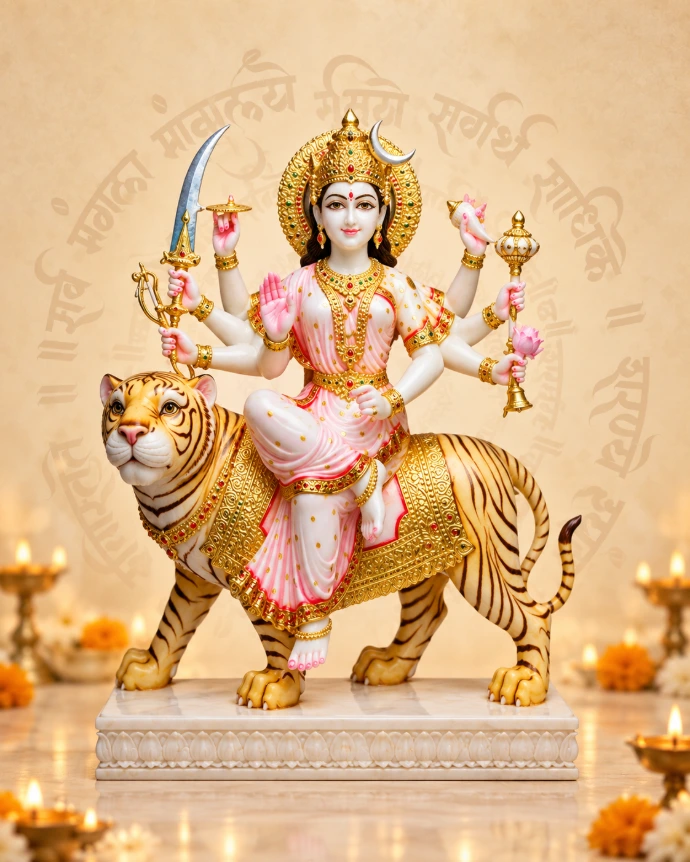
Chandraghanta is traditionally recognised by the crescent moon adorning her forehead, resembling a bell. She is generally depicted as a warrior Goddess, mounted on a tiger or lion and carrying weapons.
The third day transforms the quiet austerity of Brahmacharini into active courage.
Her bell is significant in devotional imagination: its sound can be understood as announcing the presence of Devi and driving away fear.
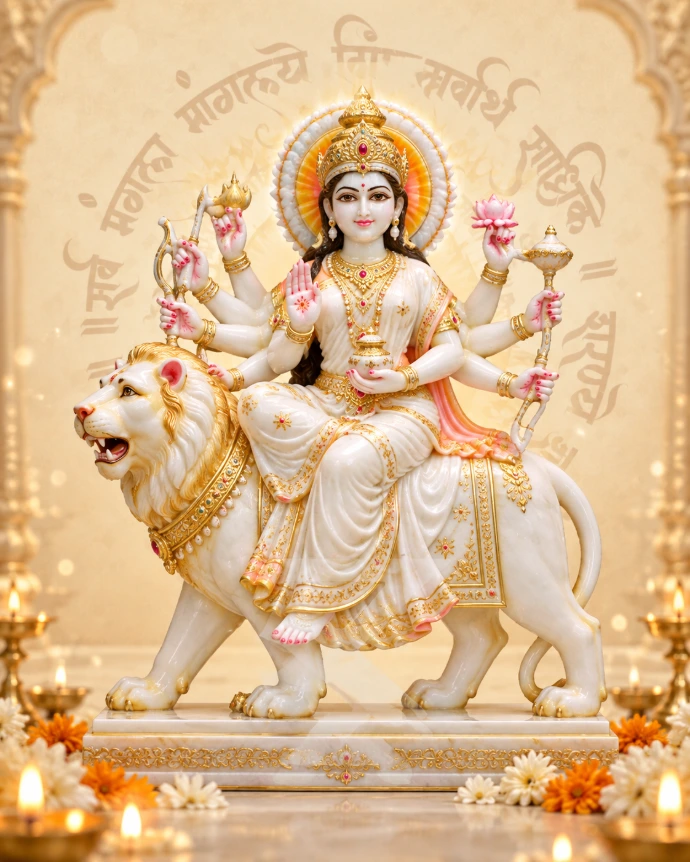
Kushmanda occupies a fascinating place in the Navdurga tradition. Her name is traditionally connected with the cosmic anda, or egg, and she is associated with the creation and radiance of the universe.
Traditional accounts describe her as possessing the power to dwell within the Sun and radiate energy.
Her imagery is therefore filled with light, vitality and creative force.
The symbolism becomes particularly beautiful during Navratri: after establishing herself in the first three forms, Devi becomes the radiance that animates existence.
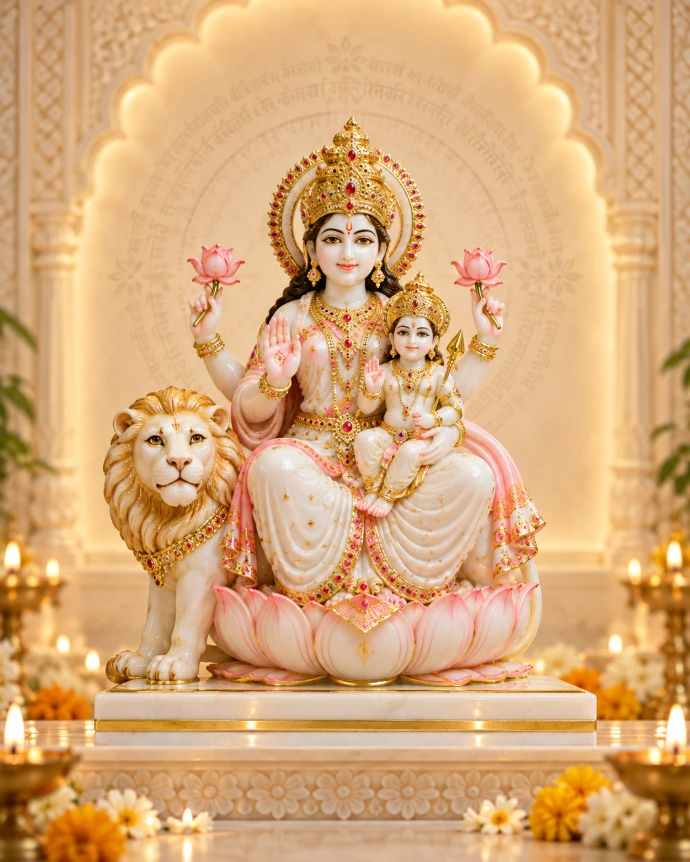
On the fifth day, Devi appears as Skandamata, the mother of Skanda, also known as Kartikeya or Murugan.
She is traditionally shown seated on a lotus, holding the infant Skanda in her lap. Her imagery combines maternal tenderness with the majesty of the lion, showing that motherhood is not weakness — it can be one of the strongest forms of protection.
The image is especially moving because the warrior deity Skanda himself appears as a child in his mother's arms.
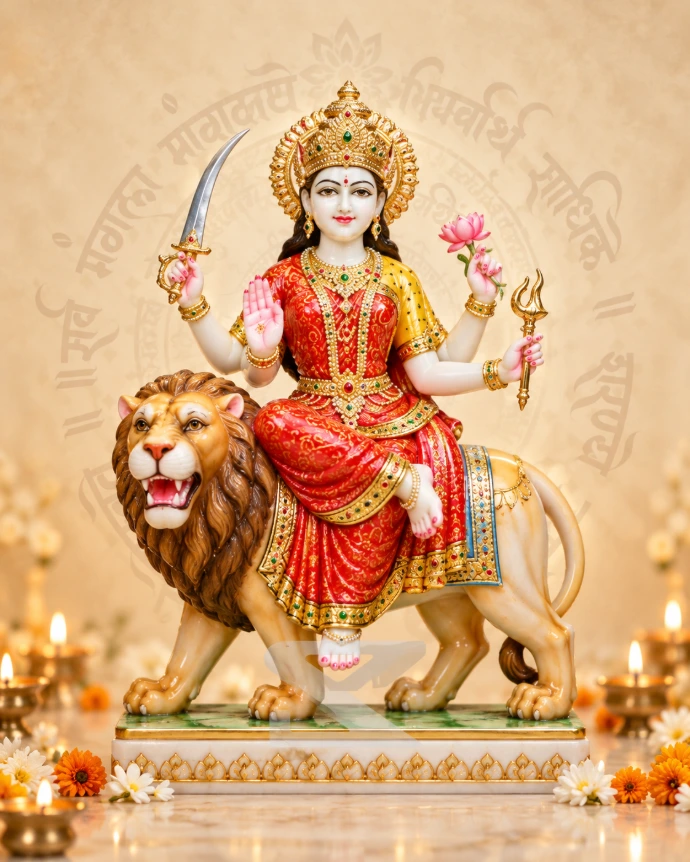
Katyayani is among the most celebrated forms of Devi during Navratri.
In the popular Navdurga tradition, she is associated with the Goddess's battle against Mahishasura. She represents the fierce, decisive power of Shakti confronting destructive forces.
Katyayani also has an important connection with the Bhagavata Purana. The young women of Vraja are described as observing a month-long vow to Katyayani, bathing in the Yamuna and worshipping the Goddess with the desire to attain Krishna as their husband.
This episode is a reminder that Devi worship has never been confined to a single emotional register. Katyayani can be the warrior Goddess and the recipient of an intimate devotional vow.
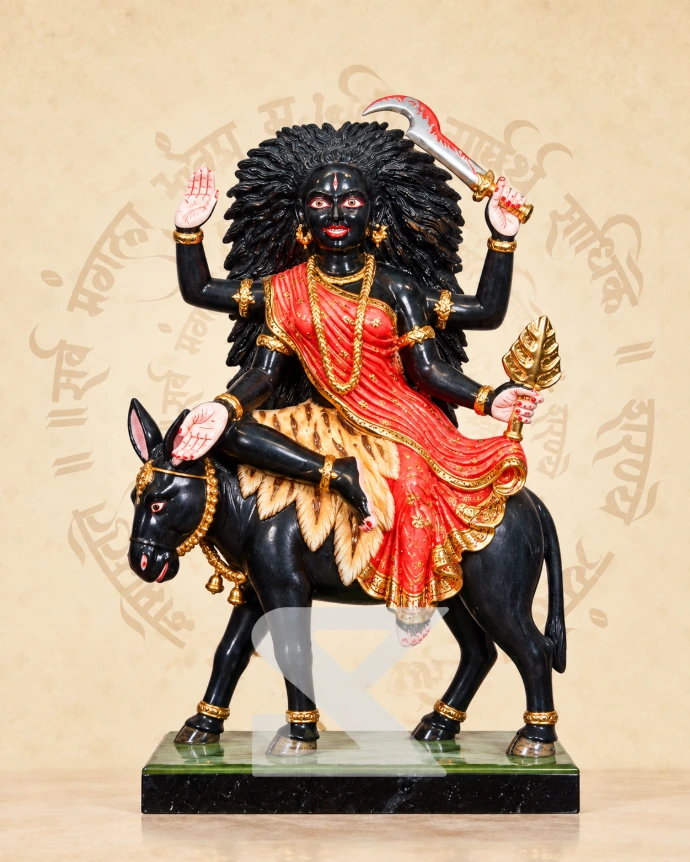
Kalaratri is perhaps the most visually formidable of the nine forms.
Her dark complexion, flowing hair and fierce expression symbolise a Goddess who does not turn away from fear. She represents the force that enters darkness and destroys what threatens dharma.
Popular Navdurga traditions describe her as the fierce manifestation of Parvati associated with the destruction of Shumbha and Nishumbha.
Her frightening appearance has a deeper cultural purpose. The Divine Mother is not required to be gentle at every moment. Sometimes compassion takes the form of standing between the vulnerable and the forces that threaten them.
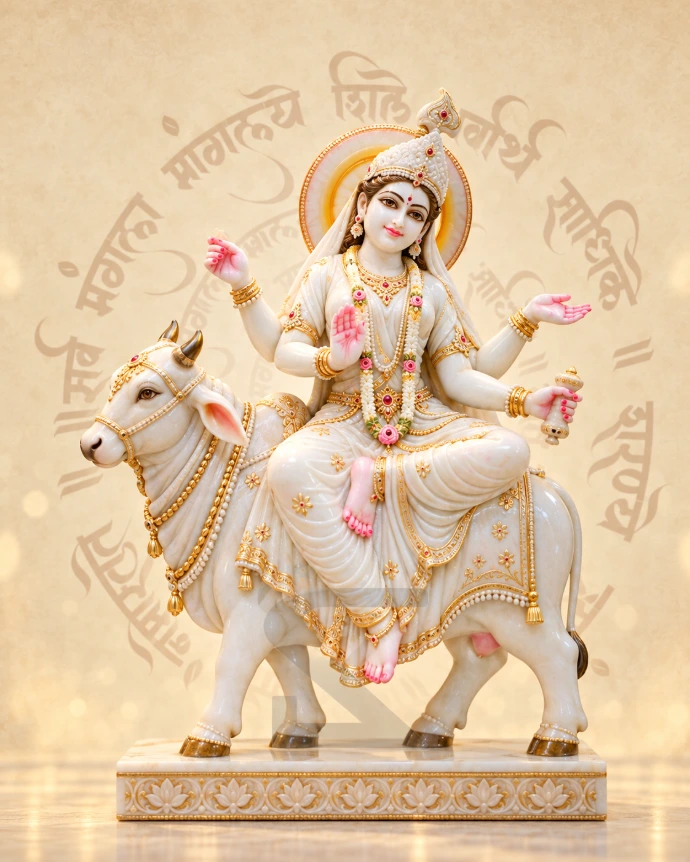
After the darkness of Kalaratri comes Mahagauri, the luminous and serene form of Devi.
She is traditionally represented in white, often riding a bull and carrying a trident and damaru. Her name means the supremely radiant or pure one.
Her appearance creates a striking emotional transition. Navratri does not remain permanently in battle. After confrontation comes cleansing, peace and renewal.
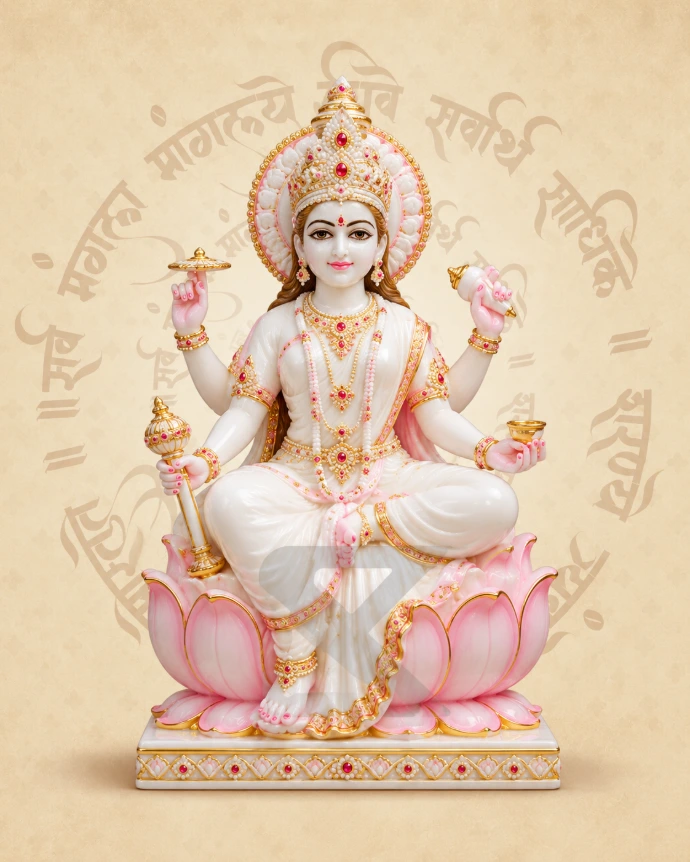
The ninth and final form is Siddhidatri, whose name refers to the bestowal of siddhis, or spiritual accomplishments.
She is traditionally shown seated upon a lotus and represents fulfilment, wisdom and divine grace. Navdurga worship therefore concludes not with another battle, but with siddhi — the fruition of the journey.
In devotional traditions, Siddhidatri is associated with the completion of the Goddess's nine-fold manifestation.
Navratri 9 Days: Colours, Forms & Offerings
The colour associated with each Navratri day is a widely followed contemporary devotional convention, but it is not uniform across India. The same applies to particular flowers, foods and bhog. Families should therefore give priority to their regional and family traditions.
| Day | Navdurga | Commonly Associated Quality | Widely Followed Colour Convention* |
|---|---|---|---|
| 1 | Shailaputri | Stability | Yellow |
| 2 | Brahmacharini | Tapas & devotion | Green |
| 3 | Chandraghanta | Courage | Grey |
| 4 | Kushmanda | Radiance | Orange |
| 5 | Skandamata | Motherhood | White |
| 6 | Katyayani | Strength | Red |
| 7 | Kalaratri | Fearlessness | Royal Blue |
| 8 | Mahagauri | Purity | Pink |
| 9 | Siddhidatri | Fulfilment | Purple |
*Colour schedules can vary by year, region and popular tradition. They should be treated as a festive custom rather than a universal scriptural command.
For devotees, the deeper meaning of the colour tradition lies not in rigidly following a colour chart but in allowing each day to carry a distinct devotional mood.
How to Worship Each Form at Home
Navratri worship can be elaborate or simple. The Devi Bhagavata Purana describes formal Navaratra observances involving a consecrated worship space, offerings, mantras, lamps and other rituals, while also emphasising devotion to the Goddess.
For an ordinary home shrine, a simple daily practice can be:
A Simple Navdurga Puja Routine
- 1. Clean the puja space — Begin each day with a clean and peaceful shrine.
- 2. Light a diya — A lamp may be lit before the image or murti of Devi according to household practice.
- 3. Offer flowers — Use flowers traditionally offered in the family or regional tradition.
- 4. Offer simple bhog — Fruit, milk, sweets or a day-specific offering may be presented according to family custom.
- 5. Chant the day's name or mantra — A beginner may simply recite the Goddess's name with Om and Namah.
- 6. Perform aarti — Conclude with a familiar Devi aarti or prayer.
- 7. Sit quietly for a moment — The final silence can be as meaningful as the ritual itself.
The Devi Bhagavata Purana also describes Kumari worship as part of Navratri observance, showing how the festival has historically included reverence for the feminine in embodied form.
Navdurga and the Home Temple: Choosing the Right Idol
During Navratri, many households create a more dedicated space for Devi worship. Some bring a temporary festival image, while others worship a permanent murti throughout the year.
A well-crafted marble Durga murti can be especially meaningful for a permanent home temple because the sculptural medium allows intricate details of Devi's face, ornaments, weapons, garments and vahana to be rendered with care.
The importance of the image also connects with India's long sculptural heritage. Traditional image-making texts developed detailed approaches to deity proportions, attributes and iconography, while Puranic and Agamic traditions describe diverse forms of Devi worship.
For a family that regularly observes Navratri, a Durga murti can become part of a much larger devotional story — present not only for nine nights but during daily prayers, festivals, family milestones and moments of remembrance.
Readers interested in the devotional significance of the Goddess's many names can also explore "108 Names of Maa Durga with Meaning" by Shilakrut. For detailed guidance on choosing a home-temple murti, the related "Which Marble Statue is Best for Home Temple?" guide provides a broader reference.
Common Mistakes to Avoid During Navratri Worship
Navratri is a time of devotion, but devotional practice does not need to become a source of unnecessary anxiety.
Avoid turning traditions into rigid rules:
- Do not assume that one colour chart applies to every region.
- Do not mix different regional rituals without understanding their context.
- Do not treat every food or bhog list found online as universally prescribed.
- Do not neglect basic cleanliness of the puja space.
- Do not rush through prayers merely to complete a checklist.
- Do not assume that elaborate rituals are the only valid form of devotion.
- Do not present regional customs as though they are direct Vedic commandments.
The Devi Bhagavata Purana itself records flexibility in observance; for example, it describes alternative ways of observing Navratri when devotees cannot perform the full nine-day practice.
At its heart, Navratri is about remembering the Mother.
Frequently Asked Questions About Navdurga
The nine commonly worshipped forms are Shailaputri, Brahmacharini, Chandraghanta, Kushmanda, Skandamata, Katyayani, Kalaratri, Mahagauri and Siddhidatri. They are traditionally worshipped sequentially during the nine days of Navratri.
The commonly followed order is: Day 1 Shailaputri, Day 2 Brahmacharini, Day 3 Chandraghanta, Day 4 Kushmanda, Day 5 Skandamata, Day 6 Katyayani, Day 7 Kalaratri, Day 8 Mahagauri, Day 9 Siddhidatri. This is the principal sequence followed in North Indian Navratri traditions, although regional and sectarian variations exist.
Each form emphasises a different quality of Devi. Shailaputri represents grounded strength; Brahmacharini, austerity and perseverance; Chandraghanta, courage; Kushmanda, creative radiance; Skandamata, motherhood; Katyayani, warrior strength; Kalaratri, fearlessness; Mahagauri, purity; and Siddhidatri, spiritual fulfilment.
Navratri colour traditions vary according to region and year. The popular colour sequence often followed today should therefore be treated as a festive custom, not an absolute scriptural rule.
No. The Shailaputri-to-Siddhidatri sequence is widely followed, particularly in North Indian Navratri worship, but other traditions preserve different nine-fold manifestations of Durga. A scholarly study of Devi traditions, for example, records a different nine-Durga list associated with the Shiva Purana.
The exact popular Navdurga sequence is not a Vedic list in the sense of a direct enumeration in the Rigveda. The Vedas provide an older theological foundation for divine feminine power — for example, the Devi Sukta of Rigveda 10.125 presents Vāk as a cosmic feminine power who sustains the gods and pervades existence. The familiar nine-form Navdurga tradition belongs to later Hindu devotional, Puranic and Agamic developments.
A Durga idol that respects traditional iconography and suits the household's devotional practice can be appropriate. Families seeking a permanent home-temple murti may consider a carefully handcrafted marble Durga statue, while temporary festival worship may follow regional traditions involving other materials and forms. For detailed guidance on choosing a permanent home-temple murti, readers can refer to Shilakrut's home-temple guide.
Established in 1971, Shilakrut brings this heritage into contemporary handcrafted marble sculpture. Its Durga murtis are created with attention to the visual language through which Devi is traditionally recognised — the serene yet powerful expression, elaborate ornaments, weapons, posture and association with the lion. The character of hand-carved marble also allows the sculptor to work carefully with facial expression and minute ornamental details, helping a sacred form retain both dignity and individuality.
For families preparing their home temple for Navratri, a thoughtfully crafted Durga murti can become a lasting presence rather than a seasonal decoration — witnessing nine nights of worship year after year. Explore Shilakrut's handcrafted Maa Durga Marble Statues and discover a representation of the Divine Mother created with traditional inspiration, skilled craftsmanship and enduring marble.
Then the days unfold.
Brahmacharini teaches patience. Chandraghanta teaches courage. Kushmanda reminds devotees of the radiance that sustains creation. Skandamata places the warrior child in the Mother's lap. Katyayani raises her weapons against Mahishasura. Kalaratri enters the darkness without fear. Mahagauri brings back the light. And finally, Siddhidatri brings the journey towards fulfilment.This progression gives Navratri its emotional depth. The Goddess is not portrayed in only one mood because life itself cannot be lived through one quality alone. There are moments when a person needs the stability of a mountain, the patience of an ascetic, the courage of a warrior, the tenderness of a mother and the wisdom to begin again.
The ancient Vedic vision of the Divine Feminine already speaks of a power that enters many forms while remaining one. In the Devi Sukta, the Goddess declares that she is present in many places and takes numerous forms.
The Puranic imagination gives this vast idea stories, names and forms that generations can remember.
And perhaps this is why Navratri remains so deeply loved across India.
For nine nights, the Mother is welcomed into homes, temples and public spaces. Children learn her names. Grandmothers pass down recipes and rituals. Families light lamps before her image. Communities sing, dance and pray. In different regions she may be Durga, Amba, Bhavani, Lalita, Katyayani, Nanda or another beloved form of Devi.
The names may change.
The rituals may change.
The colours may change.
But the underlying feeling remains remarkably constant:
the Mother is invoked as strength when the world feels uncertain, as protection when there is fear, as wisdom when there is confusion, and as hope when a new beginning is needed.
That is the enduring beauty of the nine forms of Navdurga.
They are nine names, nine images and nine devotional moods — but together they point towards one immeasurable truth.