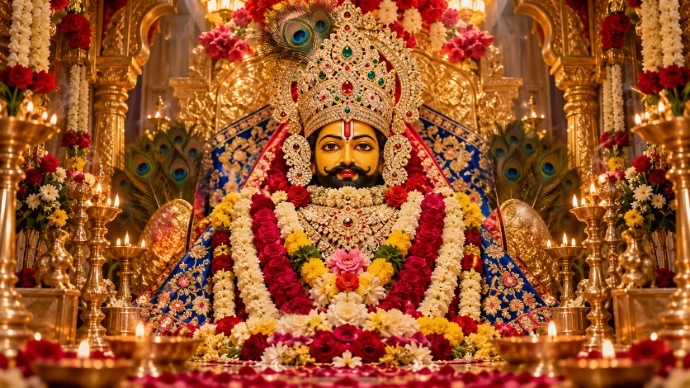
The story of Barbarika, the warrior who gave his head before the Mahabharata war, and became the beloved Khatu Shyam Baba — Haare Ka Sahara.
In the narrow lanes leading to Khatu, Rajasthan, a familiar cry rises above the sound of footsteps and temple bells: "Jai Shri Shyam!" Saffron flags flutter in the air, devotees sing bhajans, and strangers walking towards the same destination begin to feel like members of one family.
For millions of devotees, Khatu Shyam Baba is not merely a deity associated with an ancient epic. He is Haare Ka Sahara — the support of those who feel defeated, forgotten or overwhelmed by life's difficulties.
But behind this deeply personal devotion lies a remarkable story of a warrior named Barbarika, whose extraordinary strength was matched by his willingness to sacrifice everything for his word.
The story of Khatu Shyam Baba brings together the Mahabharata tradition, Krishna's divine wisdom and the living folk culture of Rajasthan. To understand why his devotees hold him so close to their hearts, we must return to the battlefield of Kurukshetra.
Who Was Barbarika?
Barbarika, also known in popular tradition as Barbareek, was the son of Ghatotkacha and the grandson of Bhima, one of the five Pandava brothers. His mother is commonly identified as Ahilavati or Maurvi in different tellings.
Born into a lineage associated with extraordinary warriors, Barbarika was remembered as a formidable archer. Popular devotional accounts describe him as possessing three exceptionally powerful arrows, known as Teen Baan, which could accomplish what an entire army might struggle to achieve.
According to these traditions, one arrow could mark the targets, another could destroy them, and the third could return to its owner. Their precise functions vary across retellings, but their symbolic meaning remains consistent: Barbarika possessed extraordinary power that required extraordinary restraint.
Yet strength was not the quality that would ultimately define him.
Before setting out for Kurukshetra, Barbarika made a promise to his mother. He would always support the side that was losing the battle.
It was a vow born of compassion for the weaker party. But as the great war approached, that promise created a dilemma that even the mighty Krishna would have to confront.
The Vow That Troubled Krishna
When the Pandavas and Kauravas prepared for the eighteen-day war, Barbarika wished to witness the battle and participate in it.
On his way to Kurukshetra, according to the popular story, he encountered Krishna, who appeared in the disguise of a Brahmin. Krishna asked the young warrior about his weapons and his intentions.
Barbarika explained his vow: he would fight for whichever side was weaker.
Krishna immediately recognised the difficulty.
Suppose Barbarika joined the Pandavas. His unmatched power would help them overcome the Kauravas. The Kauravas would then become the weaker side, prompting Barbarika to switch allegiance. His new intervention would reverse the balance once again.
The cycle could continue until neither army remained capable of winning.
A promise intended to protect the weaker side could therefore prolong the destruction of both sides.
To understand Barbarika's power, Krishna is said to have challenged him to demonstrate the precision of his arrows. In one popular version, the challenge involved piercing every leaf on a tree with a single arrow.
Barbarika's arrow located the leaves, even accounting for a leaf hidden beneath Krishna's foot in some retellings. The demonstration revealed that his abilities were no ordinary feat of archery.
Krishna now understood the full implications of allowing Barbarika to enter the war.
The question was no longer whether Barbarika could fight. It was whether he could honour his promise without changing the destiny of the battlefield.
The Supreme Sacrifice: Barbarika's Sheesh Daan
Krishna, still disguised as a Brahmin in the popular telling, asked Barbarika for dakshina — a gift offered in response to a request.
The request was extraordinary: Barbarika's head.
For most warriors, such a demand would have been unthinkable. His life, skill and weapons represented everything he had trained to become. Yet Barbarika had built his identity around keeping his word.
He agreed to offer his head.
This act is remembered as Sheesh Daan, the supreme gift of the head. It became the defining moment in the story of Khatu Shyam Baba.
However, Barbarika had one request of his own. He wished to witness the entire Mahabharata war, the very battle he had hoped to join.
Krishna granted his wish. According to popular devotional tradition, Barbarika's head was placed upon a hill overlooking the battlefield, allowing him to observe the war without intervening.
For eighteen days, he witnessed the struggle unfold.
Imagine the view from that hill: the clash of armies, the fall of great warriors, the anguish of families and the gradual transformation of a battlefield into a landscape of grief. Barbarika, who had arrived hoping to demonstrate his strength, became a witness to the terrible cost of war.
His sacrifice also carries a profound ethical question. Is courage always about fighting, or can it sometimes mean stepping away from power when its use would cause greater harm?
In the devotional understanding of the story, Barbarika's greatness lies not simply in his three arrows but in his willingness to surrender them — and himself — when the greater good demanded it.
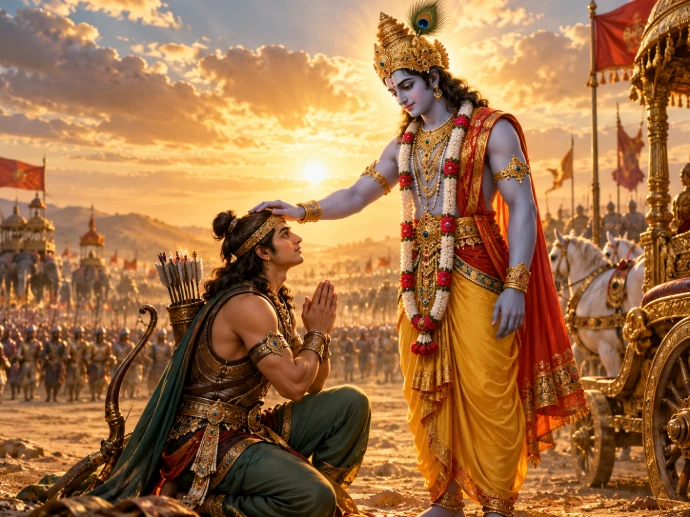
Krishna's Blessing: How Barbarika Became Shyam
When the war ended, a question arose among the Pandavas: who deserved the credit for their victory?
Each warrior had played a part. Bhima had fought with immense strength; Arjuna had demonstrated extraordinary skill; and the other Pandavas and their allies had made sacrifices of their own.
Krishna directed them towards Barbarika's head, which had witnessed the entire battle.
According to the popular account, Barbarika explained that the decisive force throughout the war had been Krishna's divine presence. The warriors had fought, but the larger movement of events had been guided by a power beyond their individual abilities.
His answer reflected humility. Even after witnessing the greatest warriors of the age, Barbarika did not claim that strength alone had determined the outcome.
Moved by his sacrifice and devotion, Krishna granted him a blessing. In the Kali Yuga, Barbarika would be worshipped by Krishna's own name, Shyam, and would become a refuge for those who turned to him with sincere faith.
The name Shyam is traditionally associated with Krishna. Through this blessing, Barbarika's story became inseparable from Krishna devotion.
This narrative is especially prominent in popular North Indian devotional tradition and is associated with versions of the Mahabharata story beyond the familiar core narrative. The distinction matters: the complete Khatu Shyam Baba story should not be presented as an episode found identically in every version of the Mahabharata.
How Khatu Shyam Baba Got His Name: A Rajasthani Folk Legend
The story does not end on the battlefield.
According to a beloved local tradition, Barbarika's head eventually came to be associated with the village of Khatu in present-day Sikar district, Rajasthan. Over time, the village became the centre of a major pilgrimage dedicated to Shyam Baba.
One of the most enduring legends concerns a cow.
Villagers are said to have noticed that a cow repeatedly released milk at a particular spot on the ground, even without being milked. Curious about this unusual behaviour, they investigated the place. The earth was excavated, and a sacred head was discovered.
The story also tells of Roop Singh Chauhan, a local ruler who received a dream directing him to the location. The discovery and the dream were understood as signs that the divine presence had revealed itself.
The place became associated with Shyam Kund, the sacred water body near the temple, and a shrine was established to honour the deity.
Rajasthan's oral traditions preserve variations of this account. Details concerning the discovery, the ruler's dream and the early temple differ across tellings, so they are best understood as sacred local folklore rather than independently verified historical events. Rajasthan Tourism also recounts the cow and discovery traditions in its account of Khatu Shyam Ji.
What makes this folklore so powerful is its setting. The divine does not reveal itself through a royal proclamation or a battlefield victory. It appears in an ordinary village, through the familiar relationship between a cow, the land and the people who depend upon it.
In a region where cattle, agriculture, monsoon cycles and village life have long shaped everyday culture, the image of a cow spontaneously offering milk becomes a meaningful expression of devotion. The story gives the landscape itself a sacred memory.
Khatu is no longer simply a place on a map. For devotees, it is the place where Krishna's promise to Barbarika became tangible.
Why Khatu Shyam Baba Is Called Haare Ka Sahara
Haare Ka Sahara means the support of those who have lost or been defeated. The title captures the emotional heart of Khatu Shyam Baba's worship.
Barbarika's vow was to support the weaker side. His sacrifice meant he never entered the battle as a conventional victorious warrior. Instead, his story came to represent compassion for those who struggle, lose or find themselves without support.
Devotees often turn to Shyam Baba during moments of uncertainty: a difficult examination, a business setback, family troubles, financial pressure or the loss of a loved one.
For many, prayer does not mean expecting every problem to disappear immediately. It offers a way to express fear, find courage and continue when the next step feels difficult.
A well-known devotional sentiment is:
"Haare Ka Sahara, Baba Shyam Hamara."
The phrase is not simply a slogan. It condenses the story of Barbarika into a few words: when worldly strength fails, the devotee seeks the assurance of divine companionship.
Khatu Shyam Baba's appeal also crosses regional boundaries. Although Rajasthan remains central to his worship, devotees travel from Haryana, Delhi, Uttar Pradesh, Gujarat, Maharashtra and other parts of India.
His popularity reflects a wider pattern in Indian devotional culture: the relationship between devotee and deity is often expressed through personal trust, songs, vows and the belief that the divine listens to ordinary people's concerns.
The Falgun Mela: When Rajasthan Walks Towards Shyam Baba
Every year, during the Hindu month of Phalgun, Khatu becomes the destination for one of Rajasthan's best-known devotional gatherings: the Falgun Mela, also called the Lakhi Mela.
The festival is associated with Phalgun Shukla Ekadashi and the surrounding days, although the exact calendar dates change from year to year.
One of its most recognisable traditions is the Nishan Yatra. Devotees carry colourful flags, known as nishans, as offerings to Shyam Baba. Groups of pilgrims walk towards Khatu singing bhajans, chanting "Jai Shri Shyam" and sharing food and assistance along the route.
The journey from Ringas to Khatu is especially well known. For some devotees, the walk is an expression of gratitude after a wish has been fulfilled; for others, it is a prayer undertaken during a difficult period.
The pilgrimage has also adapted to contemporary life. Devotees increasingly use digital information services to check darshan arrangements, travel routes and festival updates before setting out. Live darshan and online devotional content help people who cannot travel remain connected to the shrine.
Yet the heart of the festival remains deeply physical and communal: walking, singing, carrying a flag, waiting for darshan and meeting people who share the same faith.
The Falgun Mela demonstrates how an old devotional story continues to shape modern cultural life. It brings together local vendors, transport workers, hospitality providers, volunteers, temple services and pilgrims from distant places.
For a visitor, the experience is not only about reaching a shrine. It is about becoming part of a moving community.
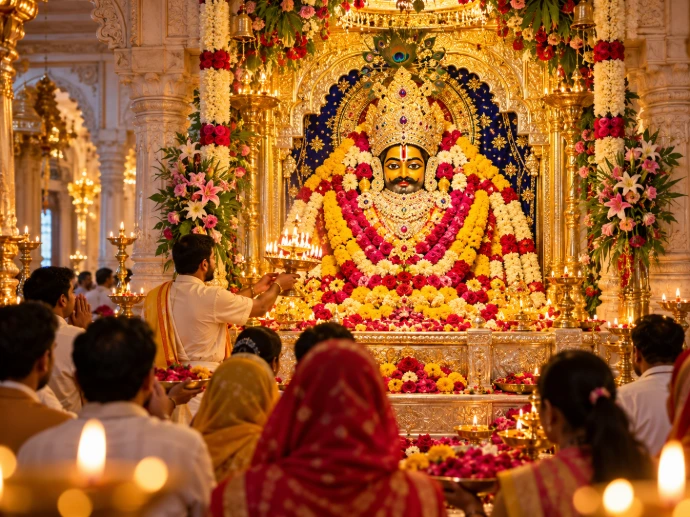
Bringing Khatu Shyam Baba Home
For devotees who cannot visit Khatu regularly, a sacred space at home can offer a quieter way to maintain their devotional connection.
A thoughtfully chosen Khatu Shyam Baba murti can become the focus of daily prayer, bhajan and moments of reflection. The choice of material, facial expression, finish and proportions helps determine how the statue sits within the home mandir.
Shilakrut's handcrafted marble Khatu Shyam Baba statues offer an option for devotees who appreciate the lasting beauty of marble and the care involved in traditional sculptural work.
A murti is not merely an interior accessory. For a devotee, it is a reminder of the story behind the name: the courage to keep one's word, the humility to recognise a greater purpose and the hope that even difficult days can be faced with faith.
Explore the Marble Khatu Shyam Baba statue collection at Shilakrut to find a design suited to your devotional space.
Frequently Asked Questions About Khatu Shyam Baba
Khatu Shyam Baba is worshipped as the manifestation of Barbarika, the son of Ghatotkacha and grandson of Bhima. According to popular devotional tradition, Krishna blessed him to be worshipped by the name Shyam in the Kali Yuga.
Barbarika had vowed to support whichever side was losing. Given his extraordinary power, Krishna recognised that his repeated intervention could prevent the war from reaching its intended conclusion. The request for his head became the story's central act of sacrifice.
The title means "support of the defeated". It comes from Barbarika's vow to help the weaker side and the devotional belief that Shyam Baba offers hope and strength to people facing difficult circumstances.
The main Khatu Shyam Ji Temple is in Khatu village, Sikar district, Rajasthan. Ringas Junction is a commonly used railway access point for pilgrims travelling to the shrine.
Barbarika is described in popular tradition as the son of Ghatotkacha and grandson of Bhima, making him part of the Pandava lineage.
The Falgun Mela is a major annual pilgrimage gathering at Khatu Shyam Temple during the Hindu month of Phalgun. It features darshan, devotional singing and the Nishan Yatra. Dates and arrangements should be checked through current temple or official pilgrimage updates.
The story of Khatu Shyam Baba begins with a warrior's promise and reaches its deepest meaning through sacrifice. Barbarika's extraordinary arrows made him powerful, but his willingness to surrender his head made him a symbol of humility and devotion.
Through the folklore of Khatu, the rituals of the Falgun Mela and the countless voices calling "Jai Shri Shyam", that story continues to live.
For devotees, Haare Ka Sahara is a promise of hope when the way forward seems uncertain.
Bring the spirit of Shyam Baba into your home with Shilakrut's handcrafted marble murtis. Explore the collection or speak with the team to plan a statue that reflects your devotional preferences and the character of your home mandir.