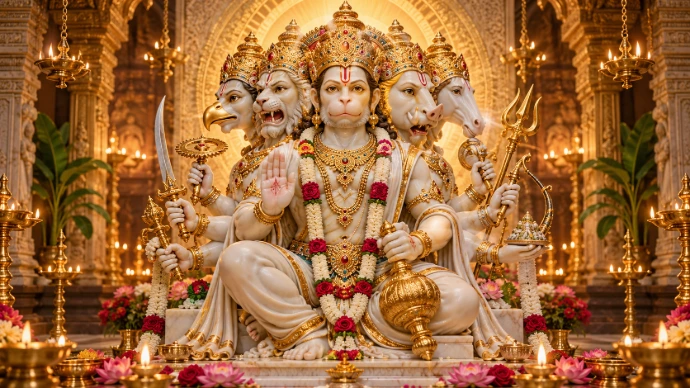
Five faces, ten arms and a presence that seems to look beyond every horizon — Panchmukhi Hanuman is one of the most striking forms in Hindu iconography. Yet the meaning of this unusual image goes far beyond its dramatic appearance.
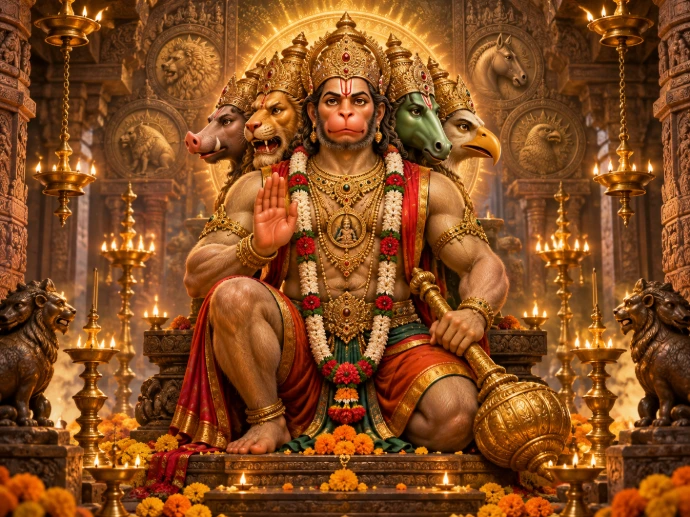
The word Panchmukhi means "five-faced". In this form, Hanuman is depicted with the faces of Hanuman, Narasimha, Garuda, Varaha and Hayagriva. Together, they represent devotion, courage, divine protection, strength and wisdom.
For devotees, Panchmukhi Hanuman is a guardian invoked for courage and protection during difficult times. His story is also a reminder that strength is most meaningful when guided by intelligence, loyalty and selfless service.
But why did Hanuman assume five faces? What does each face represent, and how did this form become part of India's devotional traditions? The answers lie in a remarkable story from the many retellings of the Ramayana.
Who Is Panchmukhi Hanuman?
Panchmukhi Hanuman, also known as Panchamukha Anjaneya, is a five-faced manifestation of Hanuman worshipped in several Hindu traditions.
Unlike the familiar single-faced Hanuman, who is often shown kneeling before Rama, carrying a mountain or standing with a mace, Panchmukhi Hanuman combines five distinct divine identities in one image.
The central face is generally Hanuman's own. The other four belong to Narasimha, Garuda, Varaha and Hayagriva. The faces are conventionally associated with different directions, giving the image a powerful sense of vigilance and encompassing awareness.
In devotional practice, this form is associated with overcoming fear, guarding against adversity and cultivating spiritual discipline. These are religious meanings and expressions of faith, rather than scientifically established effects.
The form is especially interesting because it brings together figures associated with different aspects of Hindu sacred tradition. Hanuman is the devoted servant of Rama; Narasimha and Varaha are forms of Vishnu; Hayagriva is associated with knowledge; and Garuda is Vishnu's mighty mount.
Panchmukhi Hanuman thus expresses a vision of divine powers working together through a single protective presence.
The Story Behind the Five Faces: Hanuman and Ahiravana
The best-known explanation for Panchmukhi Hanuman comes from the Ahiravana, or Mahiravana, episode in later and regional Ramayana traditions.
This distinction is important. The episode is not found in the familiar narrative of Valmiki's Ramayana. It appears in later retellings, including the Bengali Krittivasi Ramayana, as well as in other devotional and regional traditions. Details vary between versions.
According to the popular story, Ravana sought the help of Ahiravana, a powerful ruler associated with Patala Loka, the netherworld. Through deception or supernatural powers, Ahiravana abducted Rama and Lakshmana and carried them away to his subterranean realm.
Hanuman discovered that the brothers were missing and set out to rescue them.
His journey took him into a strange world of hidden passages, supernatural guardians and formidable enemies. Yet his greatest challenge was not simply finding Rama and Lakshmana. He had to discover how Ahiravana could be defeated.
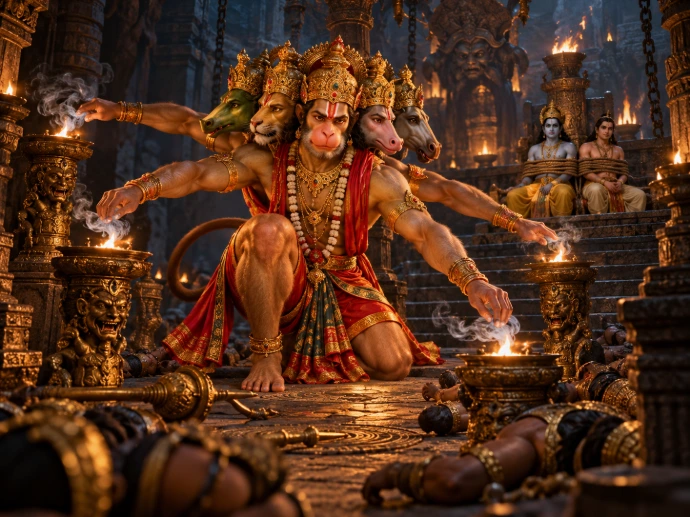
In a widely told version, Ahiravana's life was protected by five lamps burning in different directions. All five had to be extinguished simultaneously. As long as the lamps continued to burn, Ahiravana could not be killed.
Ordinarily, a warrior could extinguish only one lamp at a time. Hanuman, however, recognised that the challenge required a form capable of acting in several directions at once.
He manifested as Panchmukhi Hanuman.
With five faces turned towards different directions, he extinguished the lamps simultaneously and defeated Ahiravana. Rama and Lakshmana were rescued, and Hanuman's devotion once again proved stronger than the forces working against them.
The story transforms an unusual iconographic detail into a meaningful narrative. The five faces are not merely an embellishment to make Hanuman appear more powerful. They represent the ability to respond to several challenges at once, guided by courage and clear purpose.
The episode also offers a compelling lesson: devotion does not mean relying on strength alone. Sometimes, success requires recognising the nature of a problem and finding a new way to meet it.
The Five Faces of Panchmukhi Hanuman and Their Meaning
Each face has its own iconographic identity and devotional associations. In the commonly recognised arrangement, Hanuman faces east, Narasimha south, Garuda west, Varaha north and Hayagriva upwards. Some traditions and artistic representations vary in their precise arrangement.
1. Hanuman — Devotion, Courage and Selfless Service (Direction: East)
Hanuman's own face forms the central identity of Panchmukhi Hanuman. It represents unwavering devotion to Rama, extraordinary courage and the willingness to place service above personal ambition.
The Ramayana repeatedly presents Hanuman as more than a physically powerful warrior. His intelligence, diplomacy, humility and ability to act decisively make him indispensable to Rama's mission.
When Hanuman crosses the ocean in search of Sita, he faces a series of obstacles but does not abandon his purpose. His success comes from a combination of confidence, discernment and devotion.
In Panchmukhi Hanuman, this face reminds devotees that strength should serve a higher purpose. Courage becomes meaningful when it is guided by loyalty, responsibility and compassion.
2. Narasimha — Fearlessness and the Destruction of Evil (Direction: South)
Narasimha, the man-lion form of Vishnu, is one of Hinduism's most powerful images of divine intervention.
The Bhagavata Purana narrates the story of Prahlada, the young devotee of Vishnu, and his father Hiranyakashipu. The latter believed himself invincible and demanded that everyone acknowledge his supremacy.
When Prahlada continued to worship Vishnu, Hiranyakashipu challenged him to show where his God could be found. Vishnu then manifested as Narasimha, emerging from a pillar and defeating the tyrant in a manner that fulfilled the conditions of the boon protecting him.
This story explains why Narasimha is associated with the protection of devotees and the defeat of arrogance.
In Panchmukhi Hanuman, the Narasimha face represents fearlessness and the courage to confront destructive forces. It reminds worshippers that power without humility can become tyranny, while righteous strength serves to protect the vulnerable.
3. Garuda — Swiftness, Vigilance and Freedom (Direction: West)
Garuda, the mighty bird associated with Vishnu, occupies a distinctive place in Hindu mythology.
The Mahabharata recounts his extraordinary quest to obtain amrita, the nectar of immortality, to secure the freedom of his mother, Vinata, from servitude. His courage, intelligence and determination made him one of the most celebrated figures in the epic tradition.
Garuda's image is associated with speed, vigilance and the ability to rise above obstacles. In devotional interpretations, he is also connected with protection from serpents and poisonous influences.
Within Panchmukhi Hanuman, the Garuda face adds the symbolism of swift action and alertness. It suggests that a challenge may require not only courage but also the ability to recognise danger early and respond without hesitation.
4. Varaha — Strength, Stability and Restoration (Direction: North)
Varaha, the boar incarnation of Vishnu, is associated with the restoration of cosmic order.
In Puranic accounts, the earth is submerged beneath the cosmic waters by the asura Hiranyaksha. Vishnu assumes the form of Varaha, dives into the waters and raises the earth, restoring it to its proper place.
The story is a striking image of rescue and renewal. The divine takes a form capable of reaching into the depths and bringing the world back into balance.
As one of the faces of Panchmukhi Hanuman, Varaha symbolises strength, steadiness and the capacity to restore what has been disrupted.
For devotees, this association can serve as a reminder to remain grounded during uncertain times and to rebuild patiently after adversity.
5. Hayagriva — Knowledge, Wisdom and Discernment (Direction: Upward)
Hayagriva, the horse-headed form of Vishnu, is widely associated with knowledge, learning and the preservation of sacred wisdom.
In Puranic traditions, Hayagriva appears in accounts concerning the recovery or protection of sacred knowledge. His iconography has also become important in traditions of learning and worship, particularly among Sri Vaishnava communities.
The upward-facing position of Hayagriva in Panchmukhi Hanuman distinguishes it from the four faces oriented towards the cardinal directions.
Symbolically, it directs attention beyond immediate obstacles towards knowledge, insight and a broader understanding of one's responsibilities.
This face completes the fivefold image. Courage without wisdom can become recklessness; strength without discernment can cause harm. Hayagriva's presence reminds devotees that action should be informed by understanding.
What Do the Five Faces Represent Together?
Taken together, the five faces create a rich devotional image of protection and balanced strength.
The five faces are commonly understood as representing different divine qualities working together. They are not simply five interchangeable versions of the same figure.
Their combined meaning is especially relevant to the Ahiravana story. Hanuman's task required awareness in multiple directions, the ability to act decisively and the wisdom to understand the condition under which his enemy could be defeated.
The iconography therefore expresses a complete protective ideal: strength guided by knowledge, courage balanced by discernment and action directed towards a worthy purpose.
Is Panchmukhi Hanuman a Vedic or Puranic Form?
The distinction between Vedic literature, Puranic narratives and later devotional traditions helps explain Panchmukhi Hanuman's place in Hindu worship.
The Vedas are ancient collections of hymns and ritual knowledge. They should not be cited as the source of the familiar Ahiravana episode or the five-faced Hanuman image without specific textual evidence.
The story of Hanuman's service to Rama belongs to the Ramayana tradition. The detailed Panchmukhi episode, however, is best associated with later and regional retellings rather than attributed to Valmiki's Ramayana.
Meanwhile, the Narasimha, Varaha and Hayagriva faces draw upon wider Puranic and Vaishnava traditions. These stories provide the theological and symbolic background through which the five-faced image is understood.
Panchmukhi Hanuman worship also appears in later devotional and ritual literature. Texts and traditions associated with Panchamukha Anjaneya describe the form and its protective significance. The exact details of the story, iconography and ritual practice vary between traditions.
This layered history is part of Hinduism's living character. Sacred stories have travelled through Sanskrit texts, regional languages, temple traditions, oral storytelling, paintings and sculpture. Their variations can be acknowledged without dismissing their importance to the communities that preserve them.
Why Is Panchmukhi Hanuman Worshipped?
Devotees commonly turn to Panchmukhi Hanuman for courage, protection and strength during difficult circumstances. His five faces are understood as representing a comprehensive protective presence, extending across different directions and aspects of life.
The form is also meaningful to those who value Hanuman's association with discipline, loyalty and selfless service. The combination of five divine identities offers a reminder that overcoming adversity often requires several qualities at once.
In some households and temples, Panchmukhi Hanuman is chosen for a dedicated devotional space. Others prefer a traditional single-faced Hanuman murti, particularly one depicting Hanuman in prayer or service to Rama.
There is no single choice that every devotee must make. Worship practices differ by family tradition, regional custom and personal devotion.
Claims that a statue automatically removes negative energy or guarantees particular outcomes should be understood as matters of religious belief rather than established scientific fact. The cultural and devotional significance of the image does not depend on making such guarantees.
Panchmukhi Hanuman vs a Traditional Hanuman Murti
Both forms honour Hanuman, but their iconography emphasises different aspects of his identity.
A traditional single-faced Hanuman murti often highlights devotion to Rama, strength, humility or a specific episode from the Ramayana. A Panchmukhi Hanuman murti brings together five divine faces, emphasising comprehensive protection and the union of several sacred qualities.
When choosing between them, consider the form that resonates with your devotional intention, the style of worship practised in your family and the space available in your home mandir.
The statue's proportions, facial expression, sculptural detail and material also matter aesthetically. A well-crafted murti should express the iconography clearly, rather than relying on ornamentation alone.
Bringing Panchmukhi Hanuman Home with Shilakrut
For devotees drawn to the five-faced form, a marble Panchmukhi Hanuman murti can become a meaningful focus for prayer and reflection.
Shilakrut's handcrafted marble statue collection brings together traditional sculptural work and the enduring visual character of marble. When selecting a Panchmukhi Hanuman statue, pay attention to the clarity of all five faces, the arrangement of the attributes and the quality of the finishing.
Devotees interested in the individual divine forms may also explore a Marble Narasimha statue or a Marble Garuda statue, each representing an important part of Panchmukhi Hanuman's iconographic story.
For more devotional guidance, read Benefits of Hanuman Marble Statue at Home.
Frequently Asked Questions
Panchmukhi means "five-faced". The form combines Hanuman, Narasimha, Garuda, Varaha and Hayagriva, symbolising devotion, courage, protection, strength and wisdom.
According to popular regional Ramayana traditions, Hanuman assumed the five-faced form to extinguish five lamps simultaneously and defeat Ahiravana, rescuing Rama and Lakshmana.
They are Hanuman, Narasimha, Garuda, Varaha and Hayagriva. The commonly recognised arrangement places Hanuman towards the east, Narasimha south, Garuda west, Varaha north and Hayagriva upward.
Ahiravana, also called Mahiravana in some tellings, is a powerful ruler associated with Patala Loka in later Ramayana traditions. He abducts Rama and Lakshmana in the story explaining Panchmukhi Hanuman's manifestation.
Yes. A traditional Hanuman murti generally depicts one face, while Panchmukhi Hanuman combines five divine faces. Both are worshipped forms, and the choice depends on devotional preference and family or regional tradition.
Panchmukhi Hanuman brings together several powerful strands of Hindu sacred storytelling. The regional tale of Ahiravana explains the five-faced form, while Puranic narratives illuminate the identities of Narasimha, Varaha and Hayagriva. Garuda's epic associations and Hanuman's devotion to Rama complete the symbolism.
The result is an image that speaks of more than protection. It celebrates the meeting of courage and wisdom, strength and humility, vigilance and selfless service.
Explore Shilakrut's handcrafted marble Panchmukhi Hanuman murtis to find a design that reflects the devotional character of your home mandir.