नमस्तस्यै नमस्तस्यै नमस्तस्यै नमो नमः ॥ To that Divine Goddess who abides in all beings as Shakti, salutations again and again.
What Are the 108 Names of Maa Durga?
The 108 names of Maa Durga, traditionally known as the Durga Ashtottara Shatanamavali, are a sacred garland of names celebrating the many dimensions of the Divine Mother. Each name points towards a quality, form, power, story or spiritual attribute of Devi — from Satyā, the embodiment of truth, to Mahishasuramardini, the destroyer of Mahishasura, and Kātyāyanī, the Goddess worshipped by the young women of Vraja.
The number 108 holds a special place in Hindu devotional practice and is traditionally associated with completeness in practices such as japa and namavali recitation.
Importantly, the 108 names should not be understood as 108 separate goddesses. Rather, they offer different ways of contemplating one Divine Shakti. The same Mother can appear as compassionate Bhavani, fierce Chandika, protective Durga, contemplative Tapasvini and transcendent Brahmavadini.
This guide presents the complete list of Durga 108 names in Sanskrit, their simple transliteration and accessible English meanings, followed by their cultural context, stories from Hindu sacred literature and a practical guide to chanting.
Why Does Maa Durga Have 108 Names?
In Hindu devotional traditions, a divine name is more than a description. It becomes a way of approaching the deity through a particular quality or aspect.
The name Durga evokes the Mother who protects devotees through difficult passages. Bhavani connects her with life and existence, while Jaya and Vijaya express victory. Trinetra recalls the three-eyed vision associated with divine knowledge, and Shooladharini depicts the Goddess holding the trident.
This richness is also visible in the Devi Mahatmya, the celebrated portion of the Markandeya Purana. There, Devi appears in different manifestations to restore cosmic balance and defeat forces such as Mahishasura, Shumbha and Nishumbha. The text's narrative therefore provides an important cultural background for understanding why the Goddess is simultaneously motherly, protective and formidable.
The 108-name tradition similarly brings together apparently contrasting qualities. The list moves from truth and spiritual discipline to beauty, knowledge, weapons, motherhood, fierce forms and transcendence.
That is one of the most beautiful ideas within Shakta worship: the gentle Mother and the warrior Goddess are not two different powers. They are different expressions of Shakti.
How to Use the Durga Ashtottara Shatanamavali
The Durga Ashtottara Shatanamavali can be recited as a devotional practice, included in a home puja, used during archana or read simply as a way of contemplating the qualities of Devi.
Traditionally, names are recited with Om before the name and Namah after it — for example, Om Durgayai Namah. The complete recension used here is preserved in Sanskrit sources as a 108-name liturgical text.
For beginners, understanding the meaning can make the practice more meaningful. Instead of treating the names as a list to be completed quickly, each name can become a brief moment of contemplation.
During Navratri, families may recite the names during morning or evening worship. They may also be used during Durga Puja, Durgashtami or other Devi-oriented observances according to family and regional traditions.
108 Names of Maa Durga with Meaning
Note on the list: Sanskrit traditions preserve more than one Durga Ashtottara Shatanamavali recension. The following table follows the recension beginning with Satyai, Sadhvyai, Bhavapritayai, preserved by Sanskrit Documents as Shri Durga Ashtottarashatanamavali.
Names 1–18: Truth, Auspiciousness and Divine Consciousness| No. | Sanskrit Name | Transliteration | Meaning |
|---|---|---|---|
| 1 | सत्या | Satyā | She who is truth itself |
| 2 | साध्वी | Sādhvī | The virtuous and noble one |
| 3 | भवप्रीता | Bhavaprītā | She who is beloved of Bhava |
| 4 | भवानी | Bhavānī | The giver of existence; Divine Mother |
| 5 | भवमोचनी | Bhavamocanī | She who liberates from worldly existence |
| 6 | आर्या | Āryā | The noble and revered one |
| 7 | दुर्गा | Durgā | She who protects from difficulties |
| 8 | जया | Jayā | The victorious one |
| 9 | आद्या | Ādyā | The primordial one |
| 10 | त्रिनेत्रा | Trinetra | The three-eyed Goddess |
| 11 | शूलधारिणी | Śūladhāriṇī | Bearer of the trident |
| 12 | पिनाकधारिणी | Pinākadhāriṇī | Bearer of Shiva's bow |
| 13 | चित्रा | Citrā | The wondrous and variegated one |
| 14 | चण्डघण्टा | Caṇḍaghaṇṭā | The fierce Goddess associated with the bell |
| 15 | महातपा | Mahātapā | She of great austerity |
| 16 | मनरूपा | Manarūpā | She who is present as the mind |
| 17 | बुद्धि | Buddhi | The embodiment of intelligence |
| 18 | अहङ्कारा | Ahaṅkārā | She who manifests as the principle of ego |
| No. | Sanskrit Name | Transliteration | Meaning |
|---|---|---|---|
| 19 | चित्तरूपा | Cittarūpā | She whose form is consciousness |
| 20 | चिता | Citā | The funeral pyre; power beyond mortal existence |
| 21 | चिति | Citi | Pure consciousness |
| 22 | सर्वमन्त्रमयी | Sarvamantramayī | She who embodies all mantras |
| 23 | सत्ता | Sattā | Existence itself |
| 24 | सत्यानन्दस्वरूपिणी | Satyānandasvarūpiṇī | Embodiment of truth and bliss |
| 25 | अनन्ता | Anantā | The infinite one |
| 26 | भाविनी | Bhāvinī | She who is becoming; the beautiful Divine |
| 27 | भाव्या | Bhāvyā | She who is worthy of contemplation |
| 28 | भव्या | Bhavyā | The magnificent and auspicious one |
| 29 | अभव्या | Abhavyā | Beyond ordinary becoming |
| 30 | सदागति | Sadāgati | The eternal path or ultimate destination |
| 31 | शाम्भवी | Śāmbhavī | She who belongs to or proceeds from Shambhu |
| 32 | देवमाता | Devamātā | Mother of the gods |
| 33 | चिन्ता | Cintā | She who is contemplated upon |
| 34 | रत्नप्रिया | Ratnapriyā | She who is fond of jewels |
| 35 | सर्वविद्या | Sarvavidyā | Embodiment of all knowledge |
| 36 | दक्षकन्या | Dakṣakanyā | Daughter of Daksha |
| No. | Sanskrit Name | Transliteration | Meaning |
|---|---|---|---|
| 37 | दक्षयज्ञविनाशिनी | Dakṣayajñavināśinī | Destroyer of Daksha's sacrifice |
| 38 | अपर्णा | Aparṇā | She who undertook severe austerity without leaves |
| 39 | अनेकवर्णा | Anekavarṇā | She of many colours and manifestations |
| 40 | पाटला | Pāṭalā | Rose-coloured or radiant one |
| 41 | पाटलावती | Pāṭalāvatī | She who possesses a rosy radiance |
| 42 | पट्टाम्बरपरीधाना | Paṭṭāmbaraparīdhānā | She who is clothed in fine garments |
| 43 | कलमञ्जीररञ्जिनी | Kalamajñīrarajñinī | She whose anklets create melodious delight |
| 44 | अमेयविक्रमा | Ameyavikramā | She of immeasurable valour |
| 45 | क्रूरा | Krūrā | The fierce and formidable one |
| 46 | सुन्दरी | Sundarī | The beautiful one |
| 47 | सुरसुन्दरी | Surasundarī | The beautiful Goddess worshipped by the divine beings |
| 48 | वनदुर्गा | Vanadurgā | Durga who dwells in the forest |
| 49 | मातङ्गी | Mātaṅgī | The Goddess known as Matangi |
| 50 | मतङ्गमुनिपूजिता | Mataṅgamunipūjitā | Worshipped by Sage Matanga |
| 51 | ब्राह्मी | Brāhmī | The Shakti associated with Brahma |
| 52 | माहेश्वरी | Māheśvarī | The Shakti associated with Maheshwara |
| 53 | ऐन्द्री | Aindrī | The Shakti associated with Indra |
| 54 | कौमारी | Kaumārī | The Shakti associated with Kumara |
| No. | Sanskrit Name | Transliteration | Meaning |
|---|---|---|---|
| 55 | वैष्णवी | Vaiṣṇavī | The Shakti associated with Vishnu |
| 56 | चामुण्डा | Cāmuṇḍā | Slayer of Chanda and Munda |
| 57 | वाराही | Vārāhī | The Shakti associated with Varaha |
| 58 | लक्ष्मी | Lakṣmī | The auspicious and prosperous one |
| 59 | पुरुषाकृति | Puruṣākṛti | She who assumes the cosmic form |
| 60 | विमला | Vimalā | The pure and stainless one |
| 61 | उत्कर्षिणी | Utkarṣiṇī | She who elevates |
| 62 | ज्ञाना | Jñānā | Embodiment of knowledge |
| 63 | क्रिया | Kriyā | Embodiment of sacred action |
| 64 | नित्या | Nityā | The eternal one |
| 65 | बुद्धिदा | Buddhidā | Giver of wisdom and understanding |
| 66 | बहुला | Bahulā | The abundant and manifold one |
| 67 | बहुलप्रेमा | Bahulapremā | She who is overflowing with love |
| 68 | सर्ववाहनवाहना | Sarvavāhanavāhanā | She who rides all divine vehicles |
| 69 | निशुम्भशुम्भहननी | Niśumbhaśumbhahananī | Destroyer of Nishumbha and Shumbha |
| 70 | महिषासुरमर्दिनी | Mahiṣāsuramardinī | Destroyer of Mahishasura |
| 71 | मधुकैटभहन्त्री | Madhukaiṭabhahantrī | Slayer of Madhu and Kaitabha |
| 72 | चण्डमुण्डविनाशिनी | Caṇḍamuṇḍavināśinī | Destroyer of Chanda and Munda |
| No. | Sanskrit Name | Transliteration | Meaning |
|---|---|---|---|
| 73 | सर्वासुरविनाशा | Sarvāsuravināśā | Destroyer of all asuric forces |
| 74 | सर्वदानवघातिनी | Sarvadānavaghātinī | Destroyer of all hostile demonic forces |
| 75 | सर्वशास्त्रमयी | Sarvaśāstramayī | Embodiment of all sacred knowledge |
| 76 | सत्या | Satyā | The truthful one |
| 77 | सर्वास्त्रधारिणी | Sarvāstradhāriṇī | Bearer of all divine weapons |
| 78 | अनेकशस्त्रहस्ता | Anekaśastrahastā | She with many weapons in her hands |
| 79 | अनेकास्त्रधारिणी | Anekāstradhāriṇī | Wielder of many divine weapons |
| 80 | कुमारी | Kumārī | The youthful maiden |
| 81 | एककन्या | Ekakanyā | The one eternal maiden |
| 82 | कैशोरी | Kaiśorī | The youthful Goddess |
| 83 | युवती | Yuvatī | The young Goddess |
| 84 | यती | Yatī | The disciplined and ascetic one |
| 85 | अप्रौढा | Aprauḍhā | She who is ever youthful |
| 86 | प्रौढा | Prauḍhā | The mature and powerful one |
| 87 | वृद्धमाता | Vṛddhamātā | The ancient Mother |
| 88 | बलप्रदा | Balapradā | Bestower of strength |
| 89 | महोदरी | Mahodarī | She of the great cosmic womb |
| 90 | मुक्तकेशी | Muktakeśī | She with freely flowing hair |
| No. | Sanskrit Name | Transliteration | Meaning |
|---|---|---|---|
| 91 | घोररूपा | Ghorarūpā | She of the terrible or awe-inspiring form |
| 92 | महाबला | Mahābalā | She of immense strength |
| 93 | अग्निज्वाला | Agnijvālā | She who shines like flames of fire |
| 94 | रौद्रमुखी | Raudramukhī | She of the fierce countenance |
| 95 | कालरात्रि | Kālarātri | The dark and formidable night of time |
| 96 | तपस्विनी | Tapasvinī | The ascetic Goddess |
| 97 | नारायणी | Nārāyaṇī | The Shakti of Narayana |
| 98 | भद्रकाली | Bhadrakālī | The auspicious yet fierce form of Kali |
| 99 | विष्णुमाया | Viṣṇumāyā | The divine power of Vishnu |
| 100 | जलोदरी | Jalodarī | She who contains the waters within |
| 101 | शिवदूती | Śivadūtī | She who acts as Shiva's messenger |
| 102 | कराली | Karālī | The fearsome and formidable one |
| 103 | अनन्ता | Anantā | The infinite one |
| 104 | परमेश्वरी | Parameśvarī | The Supreme Goddess |
| 105 | कात्यायनी | Kātyāyanī | The Goddess associated with Sage Katyayana |
| 106 | सावित्री | Sāvitrī | The divine power associated with Savitṛ |
| 107 | प्रत्यक्ष | Pratyakṣā | She who is directly manifest |
| 108 | ब्रह्मवादिनी | Brahmavādinī | She who speaks of or reveals Brahman |
The Sanskrit sequence above follows the cited recension, which concludes with Kātyāyanī, Sāvitrī, Pratyakṣā and Brahmavādinī.
A note on variations: Readers may encounter a different set of 108 names beginning with Śrī, Umā, Bhāratī, Bhadra... or another recension. This does not necessarily indicate an error. Sanskrit devotional literature preserves multiple namavali traditions, and the particular text followed should be identified rather than silently mixing different lists. Sanskrit Documents itself catalogues several Durga Ashtottara Shatanamavali recensions.
The Meaning Behind Some of the Most Important Names of Maa Durga
While every name carries devotional significance, several names have become especially familiar through Navratri traditions, temple worship and the wider stories of Devi.
The name Durga is popularly understood in connection with overcoming durgati or difficult circumstances. She is therefore remembered not merely as a warrior but as a protecting Mother.
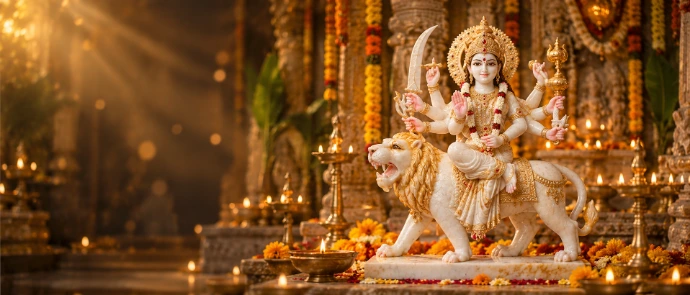
This is why the image of Durga often combines two seemingly different qualities: a serene face and powerful weapons. Her calm expression represents divine assurance; her weapons represent the strength required to confront adharma.
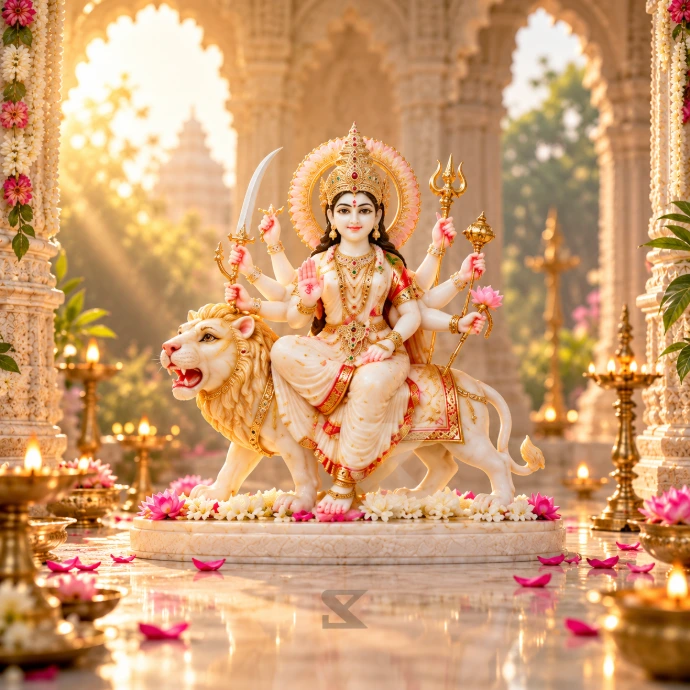
Perhaps the most recognisable warrior aspect of Devi, Mahishasuramardini recalls the famous episode of the Devi Mahatmya in which the Goddess defeats Mahishasura.
The story is not simply a tale of combat. In devotional interpretation, Mahishasura represents destructive arrogance and disorder, while Devi's victory represents the restoration of dharma. The Devi Mahatmya narrates her battle against the asura and celebrates her as the power that restores cosmic balance.
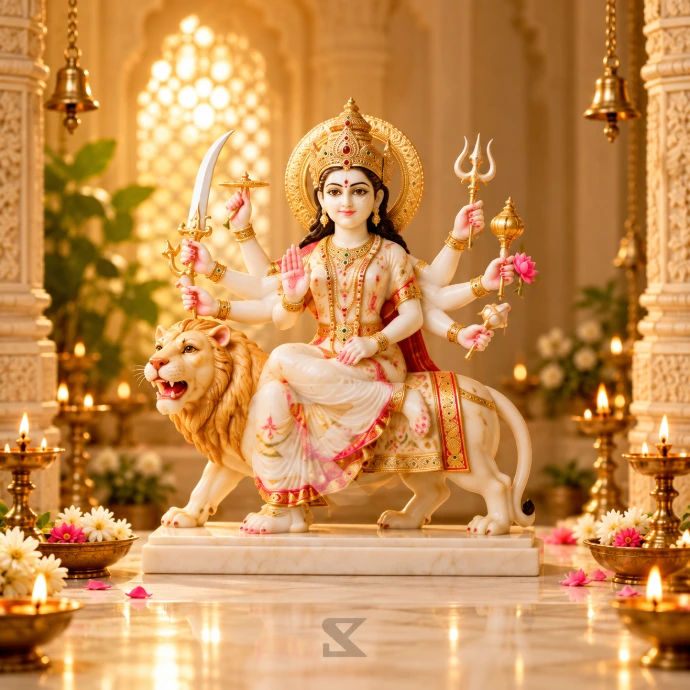
Katyayani has a particularly fascinating connection with Krishna's childhood traditions.
The Bhagavata Purana describes the unmarried young women of Vraja observing a month-long vow and worshipping Katyayani. They rose early, bathed in the Yamuna, prepared an image of the Goddess and offered flowers, incense, lamps and other offerings while praying to her.
Their prayer begins:
"Kātyāyani Mahāmāye Mahāyoginy Adhīśvari..."
The episode demonstrates how Devi worship has historically appeared within different strands of Hindu devotional practice.
Chandika represents the formidable aspect of Shakti that confronts forces threatening cosmic and moral order.
In the Devi Mahatmya, Devi's battles are not presented merely as demonstrations of physical power. They symbolise the restoration of balance when destructive forces become dominant.
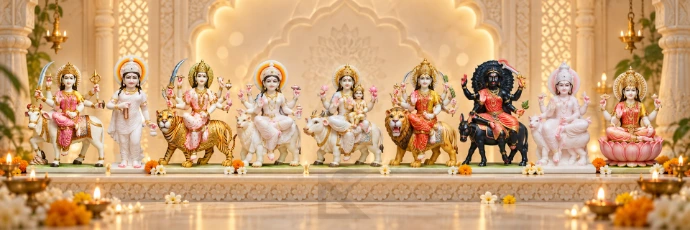
Kalratri is associated particularly with the Navadurga tradition and is one of the most powerful names encountered during Navratri.
The name evokes the darkness of cosmic time and the Goddess's ability to confront fear rather than avoid it. Her fierce appearance is therefore not intended simply to frighten; it communicates protection through strength.
The final name in this recension is Brahmavadini. It provides a striking conclusion to the namavali because the list moves from the Goddess as warrior and protector to the Goddess as a revealer of ultimate spiritual reality.
In this sense, the 108 names do not end with battle. They end with knowledge.
When Should the 108 Names of Durga Be Chanted?
There is no single universal schedule followed by every Hindu household. Regional traditions, family customs and individual sadhana differ.
The Durga 108 names are commonly included in devotional practice during:
| Occasion | How the Names May Be Used |
|---|---|
| Navratri | Morning or evening Devi worship and archana |
| Durgashtami / Maha Ashtami | Extended Devi puja and devotional recitation |
| Maha Navami | Worship and contemplation of the Divine Mother |
| Fridays | In households where Friday Devi worship is customary |
| Daily Puja | As part of a regular home-temple routine |
| Durga Puja | Alongside regional forms of Devi worship |
| Personal Prayer | For contemplation, gratitude and devotion |
Navratri is especially significant because Hindu traditions across India celebrate the Goddess through different regional forms, rituals, music, fasting practices and community worship.
The important principle is bhava — the devotional attitude with which the names are remembered.
Traditional Benefits of Chanting the Ashtottara Shatanamavali
Devotees traditionally associate the recitation of Devi's names with several spiritual intentions.
These include:
- Cultivating courage in difficult circumstances
- Remembering the protective aspect of the Divine Mother
- Developing concentration and devotional discipline
- Seeking inner strength and clarity
- Contemplating virtues such as truth, wisdom, compassion and courage
- Expressing gratitude towards Shakti
- Creating a sacred rhythm within daily worship
These should be understood as traditional devotional beliefs, not as guaranteed material or medical outcomes.
The deeper value of a namavali lies in transforming worship from simply looking at an image of Devi to remembering what the image represents.
When a devotee says Buddhidā, the Goddess is remembered as the giver of wisdom. When the devotee says Balapradā, she is remembered as the giver of strength. When the devotee says Satyā, truth itself becomes the object of contemplation.
How to Chant the 108 Names Correctly
A simple home practice can follow these steps:
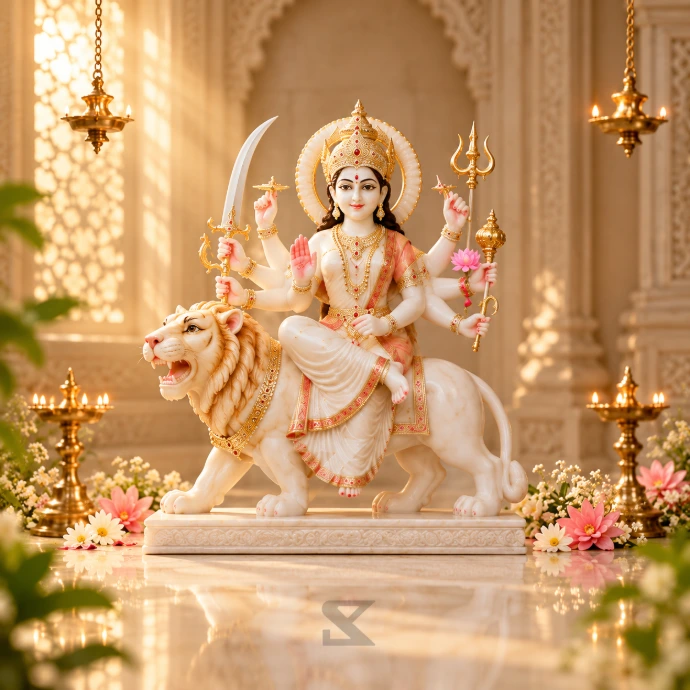
- 1. Prepare the space — Keep the home temple clean and sit comfortably before an image or murti of Maa Durga.
- 2. Light a diya — A lamp may be lit as part of the household's customary puja.
- 3. Begin with a moment of silence — Take a few moments to settle the mind before beginning the namavali.
- 4. Recite each name slowly — Use the Sanskrit pronunciation as accurately as possible. Beginners may read the transliteration alongside the Devanagari.
- 5. Understand the meaning — Where possible, contemplate the quality expressed by each name rather than rushing through all 108.
- 6. Use flowers for archana if customary — A flower may be offered with each name in a traditional archana practice.
- 7. Complete the prayer with gratitude — The recitation can conclude with a simple prayer seeking Devi's grace, wisdom and strength.
A Simple Devotional Flow
There is no need for a beginner to feel intimidated by the Sanskrit. A sincere, respectful practice undertaken according to one's family tradition is more meaningful than mechanically rushing through unfamiliar words.
Choosing the Right Durga Idol for a Home Temple
The 108 names become particularly meaningful when worship is centred on a sacred image of the Goddess.
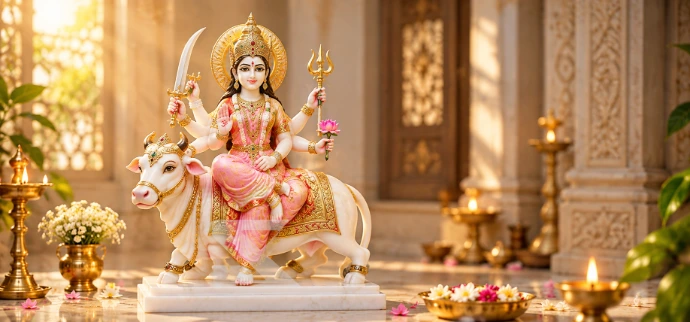
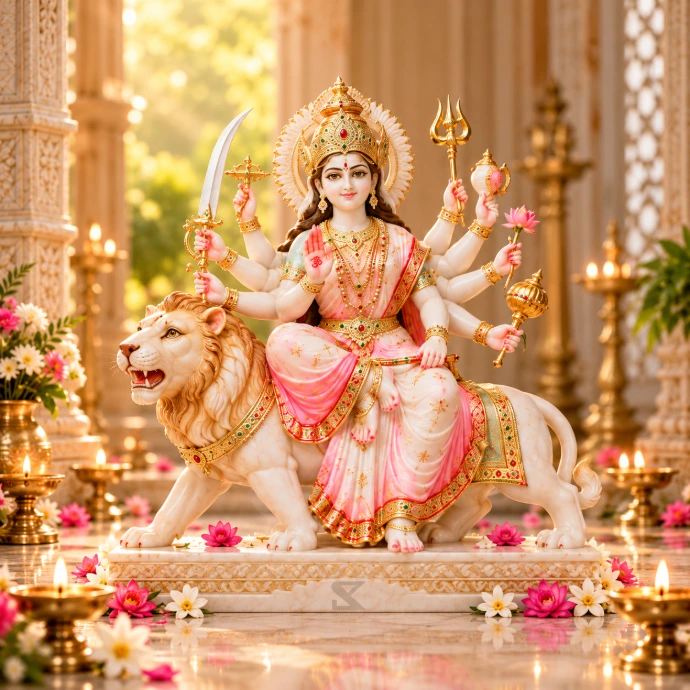
In Hindu image-making traditions, a murti is not treated merely as decorative sculpture. The form, attributes, posture and iconography of a deity communicate theological ideas. Durga's lion, weapons, multiple arms and composed expression each contribute to the visual language through which devotees recognise her protective and victorious nature.
The Bhagavata Purana, for example, describes worship of a Goddess image made from earth in the story of the Vraja gopis' Katyayani vrata. The passage also demonstrates the diversity of materials through which sacred images can be represented.
For a permanent home shrine, families may choose a carefully crafted marble Durga murti because marble allows the sculptor to articulate delicate facial expressions, jewellery, garments, weapons and other iconographic details with permanence.
The choice of idol should ultimately respect the household's worship tradition, available space and intended form of daily puja.
For detailed guidance on choosing a marble deity for a home temple, readers can also explore "Which Marble Statue is Best for Home Temple?" on Shilakrut.
Common Mistakes to Avoid When Chanting Durga's 108 Names
Avoid these common mistakes:
- Rushing through the names simply to finish all 108.
- Changing names between different recensions without realising that multiple traditional lists exist.
- Mixing Sanskrit forms from different namavalis and presenting them as one canonical list.
- Ignoring pronunciation completely when a reliable transliteration is available.
- Treating the names as magical formulas without devotional understanding.
- Assuming that every family must follow exactly the same chanting procedure.
- Making exaggerated promises about wealth, health or worldly success from chanting.
The greatest strength of the namavali is its ability to bring attention back to Devi. The practice is not a race towards 108; it is a gradual movement through 108 ways of remembering the Divine Mother.
Frequently Asked Questions About Durga's 108 Names
The 108 names of Maa Durga are known as the Durga Ashtottara Shatanamavali. They describe different qualities, manifestations, powers and attributes of Devi. Different Hindu traditions preserve different recensions of the 108 names, so the sequence may vary between sources.
The names provide different ways of contemplating the Divine Mother. Some describe her virtues, others her weapons, forms, cosmic powers, victories over demons or relationship with other divine forces. Together, they create a devotional portrait of Shakti in her many dimensions.
They may be recited during Navratri, Durgashtami, Durga Puja, Friday Devi worship, daily home puja or other occasions according to family and regional traditions. There is no single schedule that applies to every Hindu household.
Ashtottara Shatanamavali means a namavali or garland of 108 names. Ashtottara shata refers to 108, while namavali means a sequence or garland of names.
For ordinary devotional recitation, beginners can learn the names using a reliable Sanskrit text and transliteration. If undertaking a specific tantric or formally initiated spiritual practice, however, the guidance of a qualified teacher within that tradition is appropriate.
Balapradā, meaning "giver of strength," is especially direct in its meaning. Names such as Durgā, Jaya, Vijayā in traditions where that form occurs, and Mahābalā also evoke protection, strength and victory. The appropriate practice can depend on the devotee's family tradition and the particular namavali being followed.
A carefully crafted Durga murti made according to traditional iconographic principles can be appropriate for a home temple. The choice should consider the household's worship tradition, available space and the form of Devi with which the family connects. For detailed guidance on material, form and placement, readers can refer to Shilakrut's guide on choosing a marble statue for a home temple.
Shilakrut, established in 1971, carries this philosophy into handcrafted marble sculpture. Its Maa Durga murtis are created with attention to the details that make Devi's iconography immediately recognisable — from her composed expression and elaborate ornaments to her weapons, posture and association with the lion. The use of carefully selected marble and skilled hand-carving allows each sculpture to retain the character of traditional Indian craftsmanship while remaining suitable for contemporary home temples, spiritual spaces and heritage-inspired interiors.
A Durga murti can become more than an object placed inside a shrine. Over time, it can become part of the family's devotional landscape — present during Navratri, festivals, daily prayers and moments when strength is sought from the Mother. For those looking for a handcrafted representation of Maa Durga, explore Shilakrut's Maa Durga Marble Statue collection and discover sculptures created with an emphasis on traditional iconography, craftsmanship and enduring beauty.
The beauty of the Durga 108 names lies in their range.
The Goddess begins as Satyā, truth. She becomes Bhavānī, the life-giving Mother; Trinetra, the three-eyed seer; Aparṇā, the ascetic; Cāmuṇḍā, the destroyer of evil; Mahishāsuramardinī, the victorious warrior; Kātyāyanī, the Goddess of sacred vows; and finally Brahmavādinī, the revealer of the highest spiritual truth.
This movement captures something fundamental about the Hindu understanding of Devi: Shakti cannot be confined to a single expression.
She can be the Mother who comforts, the warrior who protects, the ascetic who performs tapas, the wisdom that illuminates the mind and the cosmic power through which creation itself unfolds.
That is why the 108 names remain relevant beyond Navratri. They can be read, recited and contemplated throughout the year — as a prayer, as a meditation and as a reminder that the many forms of the Divine Mother ultimately lead the devotee towards one sacred presence.
"The many names of Devi are like different windows opening towards the same infinite Divine Mother."