Across Gujarat and Rajasthan, the name Amba Mata evokes the image of a powerful yet compassionate Divine Mother who protects her devotees and guides them through life's difficulties. Revered as a form of Adi Shakti, Amba Mata holds a special place in India's devotional landscape, with the famous Ambaji Temple drawing pilgrims throughout the year.
Yet some of the most fascinating facts about Amba Mata are not widely known. Her principal shrine at Ambaji is associated with a sacred geometric symbol rather than a conventional idol, her worship connects different religious communities, and her traditions are deeply rooted in the Aravalli hills.
From the mystery of the Visa Yantra to the spiritual importance of Gabbar Hill, here are nine interesting facts that reveal the cultural and devotional significance of Amba Mata.
Her Name Means "Mother"
One of the most beautiful facts about Amba Mata lies in her name itself. "Amba" means "mother" and reflects the intimate relationship devotees share with the Divine Mother.
In Sanskrit and regional Indian traditions, the word evokes nourishment, protection, compassion and the strength of motherhood. Amba Mata is therefore approached not only as a powerful goddess but also as a caring presence who listens to prayers and offers spiritual reassurance.
Across Gujarat and Rajasthan, devotees invoke her during personal difficulties, family celebrations and important life events. Her name is often spoken with the familiarity reserved for a beloved mother.
This maternal aspect is central to her appeal. Her strength is not separate from her compassion; rather, the two work together to represent protection, courage and unconditional care.
Amba Mata Is Considered a Form of Adi Shakti
Amba Mata is revered as a manifestation of Adi Shakti, the primordial Divine Feminine. In the Shakta tradition, the goddess represents the supreme power that sustains creation, preserves cosmic order and overcomes destructive forces.
She is closely associated with Durga and Parvati, although regional traditions may emphasise different aspects of these divine forms.
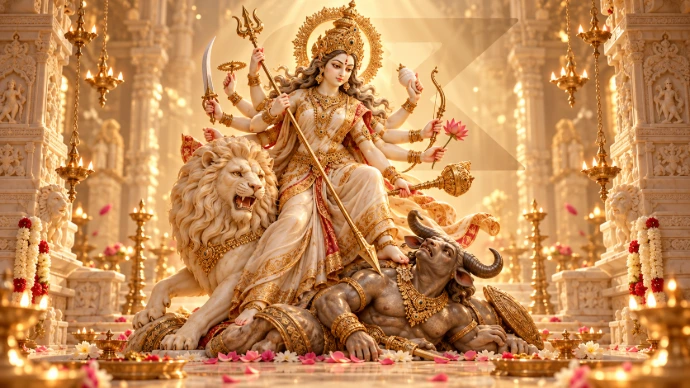
Durga is frequently portrayed as a warrior goddess who defeats forces threatening cosmic balance. Amba Mata shares this protective dimension while retaining her own distinctive regional identity and devotional traditions.
Her worship illustrates an important feature of Hindu religious culture: the Divine Mother may be approached through many names and forms, each expressing different qualities of divine power.
For devotees, Amba Mata's symbolism encompasses courage during adversity, compassion towards those in need and the inner strength required to face uncertainty.
Ambaji Temple Has No Conventional Idol
One of the most remarkable facts about Amba Mata is that the principal sanctum of the famous Ambaji Temple in Gujarat does not contain a conventional anthropomorphic idol of the goddess.
Instead, the goddess is worshipped through a sacred geometric symbol known as the Visa Yantra.
A yantra is a sacred diagram used in particular Hindu devotional and ritual traditions. Its geometry carries symbolic significance and can serve as a focus for worship and meditation.
At Ambaji, the Visa Yantra represents the goddess through a form that differs from the familiar sculpted images of Durga or other manifestations of Devi. The practice offers a striking reminder that the divine need not always be represented through a human-like figure.
The temple's tradition is especially meaningful because it demonstrates the diversity of Hindu worship. Some devotees approach the Divine Mother through a beautifully carved murti, while others worship through a sacred symbol.
Both practices can express reverence, devotion and the understanding that divine power extends beyond any single physical representation.
Ambaji Is Traditionally Counted Among the Shakti Peethas
The Shakti Peethas are sacred places associated with the story of Goddess Sati and Lord Shiva. According to a widely known Hindu narrative, Sati's body was divided into parts as Shiva carried her following her death, and the places where these parts fell became centres of goddess worship.
Ambaji is traditionally counted among the Shakti Peethas and is one of the most important pilgrimage destinations associated with the Divine Mother in western India.
However, the number and exact locations of Shakti Peethas differ across religious texts and regional traditions. Lists commonly refer to 51 or 108 sites, among other enumerations. It is therefore more accurate to describe Ambaji's status as a long-standing and widely followed religious tradition rather than as a classification accepted identically by every source.
For devotees, the significance of Ambaji extends beyond lists and historical debates. The temple represents a living centre of Shakti worship, where generations of pilgrims have come to offer prayers and seek the goddess's blessings.
Gabbar Hill Is Considered the Goddess's Original Seat
A short distance from the main Ambaji Temple stands Gabbar Hill, an important sacred site associated with Amba Mata.
According to local religious tradition, Gabbar Hill is regarded as the goddess's original abode. It has its own shrine and pilgrimage significance, making it an important destination for devotees visiting Ambaji.
The hill also forms part of the wider sacred landscape of the Aravalli region, where natural features, local legends and religious practices have developed together over generations.
For pilgrims, visiting Gabbar Hill can be a deeply meaningful part of the journey. The landscape itself becomes part of the devotional experience, connecting the goddess with the hills and terrain that have shaped regional religious identity.
Gabbar Hill is particularly significant because it reminds visitors that a sacred tradition does not exist only within temple walls. Hills, pathways and pilgrimage routes can also carry layers of cultural memory and spiritual meaning.
Amba Mata Is Revered by Both Hindus and Jains
Amba Mata's devotional significance extends across religious communities, and Ambaji is an important pilgrimage destination for many Jain devotees, particularly those belonging to the Shwetambar tradition.
This connection reflects the long history of interaction between religious communities in western India, where pilgrimage centres, sacred landscapes and regional traditions have often developed in close proximity.
Jain religious life has its own distinct teachings, rituals and sacred figures. Nevertheless, Jain communities have also maintained relationships with regional devotional sites and protective deities, including figures revered in local traditions.
Amba Mata's importance to Jain pilgrims should therefore be understood within this wider cultural setting rather than by assuming that Hindu and Jain worship are identical.
The connection is particularly interesting because it highlights how sacred places can hold significance for different communities while allowing each to retain its own religious identity.
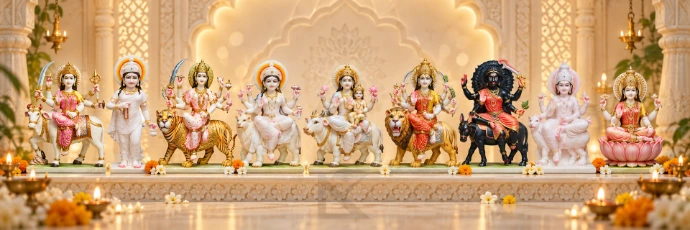
For those exploring Indian sacred art, this diversity also provides context for the range of deities and devotional figures represented in Jain and Hindu sculpture.
Ambaji Becomes Especially Important During Navratri
Navratri, the festival dedicated to the Divine Feminine, is one of the most significant periods in Amba Mata's devotional calendar.
During these nine nights, devotees honour different manifestations of the goddess through prayer, fasting, temple visits, music and community celebrations. Across Gujarat, Navratri is especially famous for Garba and Dandiya Raas, traditional dance forms performed during the festive season.
Ambaji attracts pilgrims during Navratri, when devotion to the goddess becomes part of a larger atmosphere of celebration and spiritual reflection.
For many families, the festival is an opportunity to renew their prayers, participate in community traditions and reflect on the triumph of divine power over destructive forces.
The festival also demonstrates how goddess worship continues to shape everyday cultural life. Religious observances, folk music, regional dress, dance and family customs come together to create a living tradition that passes from one generation to the next.
Amba Mata's Worship Is Rooted in the Aravalli Region
The Ambaji Temple lies in Banaskantha district of Gujarat, near the Rajasthan border, within a region closely associated with the Aravalli hills.
This landscape is important to understanding the goddess's regional identity. The Aravallis have long been home to settlements, pilgrimage routes and diverse cultural traditions, including forms of goddess worship.
Ambaji's location also places it within a wider network of sacred destinations in western India. Pilgrims may connect their visits with other temples and religious sites across Gujarat and Rajasthan, creating journeys that combine devotion with regional heritage.
The relationship between the goddess and the landscape is more than geographical. Sacred hills, local stories and pilgrimage practices give places a meaning that grows across generations.
Amba Mata's traditions therefore illustrate how regional religious identities develop through the interaction of mythology, natural surroundings, architecture and community memory.
Amba Mata Is Worshipped Beyond the Temple
Although Ambaji remains a major pilgrimage centre, Amba Mata's presence extends into everyday devotional life.
Many devotees honour the Divine Mother through household shrines, festival observances, prayers and images of Devi. For some families, worship takes place daily; for others, it becomes especially important during Navratri or at significant moments in life.
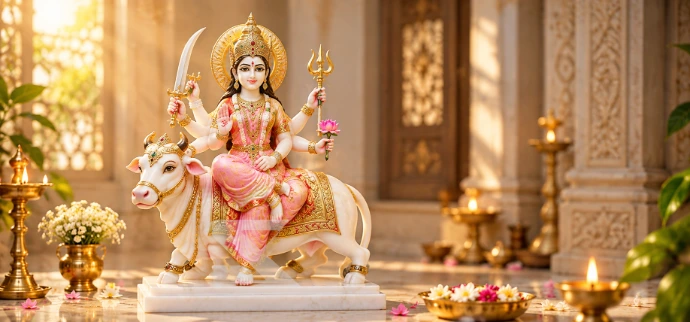
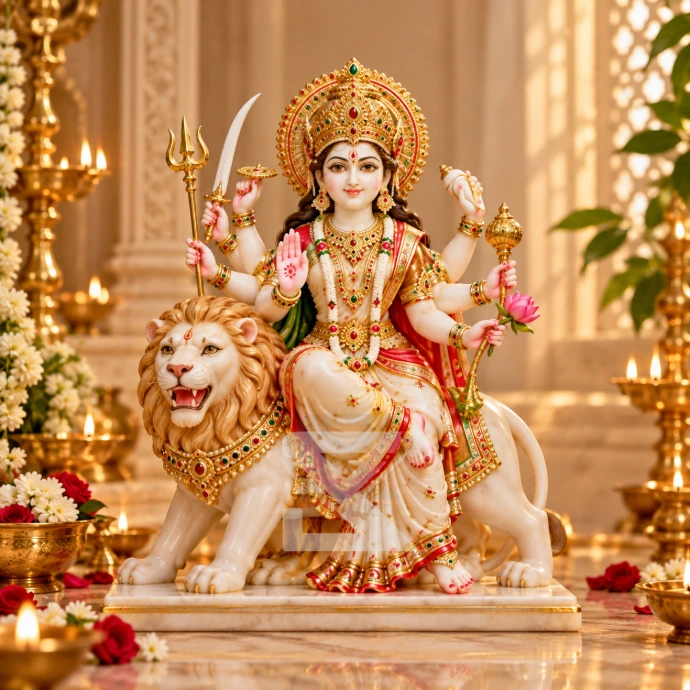
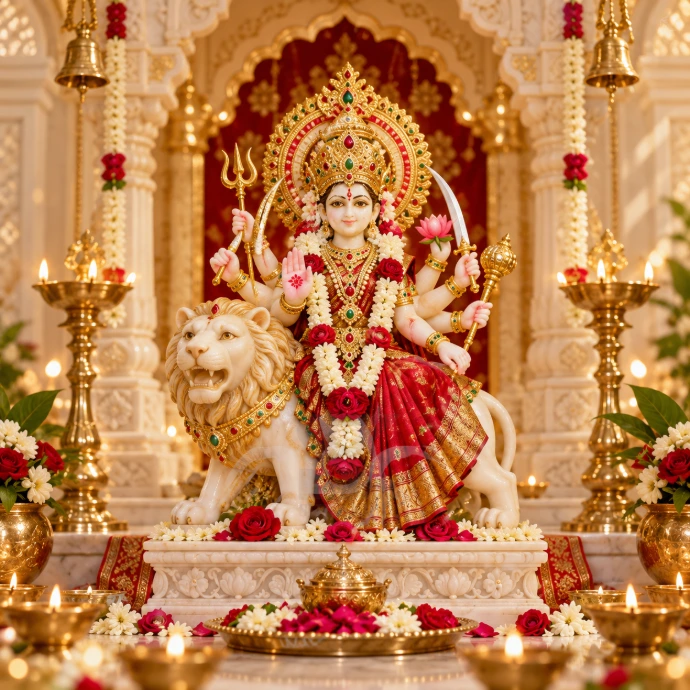
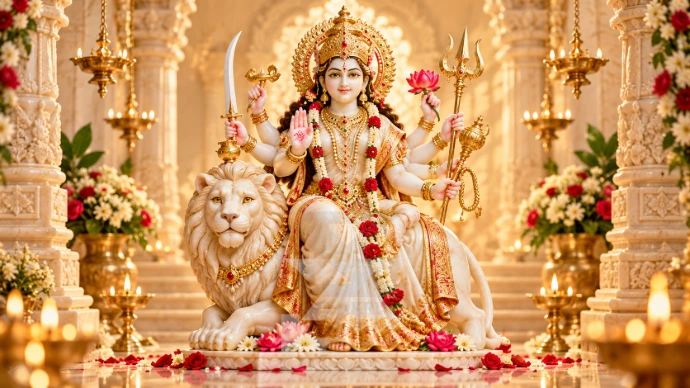
A murti of Amba Mata or Durga can provide a focal point for prayer, allowing devotees to express their connection with the goddess within their own homes.
The form chosen may vary according to family tradition, regional practice and personal preference. Some devotees favour a traditional representation of Durga with her symbolic attributes, while others are drawn to different forms of the Divine Mother.
These household practices show that devotion is not limited to a famous pilgrimage destination. It also lives in ordinary spaces, where stories, rituals and memories are carried forward through family life.
Bringing Amba Mata's Blessings Home
For devotees who cannot regularly visit Ambaji, a handcrafted Amba Mata or Durga murti can serve as a meaningful focus for worship in a home mandir.
At Shilakrut, handcrafted marble deity sculptures bring together the enduring beauty of natural stone and the detailed artistry of sacred iconography. A marble Durga Mata statue can reflect the goddess's protective strength and maternal grace, while other Devi forms offer different expressions of the Divine Feminine.
Shilakrut's wider collection also includes Jain devotional sculptures for those interested in the diverse sacred-art traditions of western India.
When selecting a murti, consider the iconography, proportions, craftsmanship and suitability of the sculpture for the intended space. The choice should reflect the devotee's tradition and personal connection with the deity.
Frequently Asked Questions About Amba Mata
Amba Mata is a revered form of the Divine Mother, commonly associated with Adi Shakti and closely connected with Durga in the wider Shakta tradition. She is especially worshipped in Gujarat and Rajasthan.
The main sanctum of Ambaji Temple is associated with the worship of a sacred geometric symbol called the Visa Yantra, rather than a conventional anthropomorphic murti.
According to widely followed Hindu tradition, Ambaji is counted among the Shakti Peethas. However, the number and exact locations of these sacred sites vary across texts and regional traditions.
Ambaji is an important pilgrimage site for many Jain devotees, particularly within the Shwetambar tradition. This reflects the historical and cultural connections between religious communities in western India.
Gabbar Hill, near Ambaji Temple, is traditionally regarded as the original abode of the goddess. It remains an important pilgrimage site associated with Amba Mata.
From the sacred Visa Yantra at Ambaji to the pilgrimage traditions of Gabbar Hill, the story of Amba Mata reveals a devotional heritage shaped by faith, landscape and cultural diversity.
Her worship reminds devotees of the strength and compassion associated with the Divine Mother, while the traditions surrounding her continue to connect communities across generations.
Explore Shilakrut's handcrafted marble Durga and Devi collections to discover sacred sculptures inspired by India's rich heritage of goddess worship and traditional craftsmanship.