There are some stories in the Indian sacred imagination that are remembered not merely as stories, but as living symbols. The story of Durga Maa and Mahishasura is one of them.
Told most prominently in the Devi Mahatmya, a celebrated section of the Markandeya Purana, the story tells of Mahishasura, the powerful asura who defeated the gods and seized their heavenly kingdom, and of the divine Goddess who arose from the combined radiance of the gods to confront him.
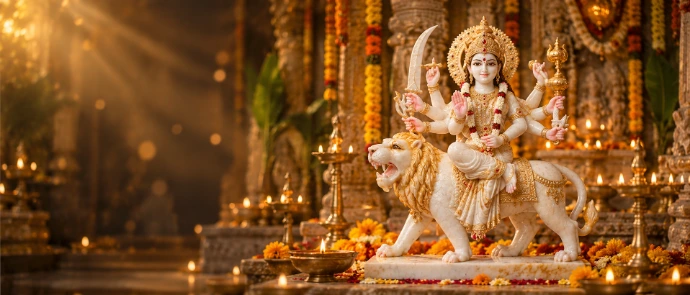
She was Durga — radiant, formidable and compassionate; the embodiment of Shakti. Riding a lion and carrying the divine weapons bestowed upon her, she entered a battle that would become one of the most enduring images of Indian sacred art.
Who Was Mahishasura?
Mahishasura was a powerful asura, traditionally represented as a being capable of assuming the form of a buffalo and other forms. His strength was accompanied by an intense desire for power, and he undertook severe austerities to obtain a boon from Lord Brahma.
The boon made Mahishasura extraordinarily difficult to defeat. In the traditional narrative, he could not be killed by a man or by the gods. Believing himself protected by this condition, Mahishasura grew increasingly powerful.
What appeared to be an impenetrable protection contained an unexpected limitation: the divine power that would ultimately defeat him would take a form outside the terms of his assumed invincibility.
Mahishasura's buffalo form is important to the symbolism of the story. The buffalo becomes associated with his immense physical force and untamed power, while the Goddess represents a higher divine force capable of bringing that power under control.
Mahishasura's Reign of Terror
With his extraordinary power behind him, Mahishasura challenged the Devas. The battle between the gods and the asuras ended in the defeat of the Devas, and Mahishasura became dominant in the heavenly realm.
The gods were driven from their positions, and the balance between the divine and demonic forces was disturbed. The Devi Mahatmya describes the gods as having been defeated and driven from heaven, with Mahishasura becoming supreme.
The Devas could not overcome Mahishasura through their individual powers.
So they turned towards a force greater than any single deity.
Brahma, Vishnu and Shiva, together with the other gods, became filled with divine energy. From their anger and radiance emerged something extraordinary — a brilliance so intense that it gathered into a single, magnificent form.
She was the Goddess. She was Chandika, Ambika, Durga.
The Birth of Goddess Durga
The birth of Durga in the Devi Mahatmya is one of the most powerful descriptions of divine feminine energy in Hindu sacred literature.
The gods release their individual tejas, or divine radiance. These streams of energy converge and take form as the Goddess. She is therefore not presented merely as another deity arriving to help the gods; she embodies the combined divine power of the gods themselves.
This is one of the theological heartbeats of the story.
The Goddess is Shakti — divine power itself.
Her appearance is accompanied by awe among the gods. They recognise that the energy which has arisen is capable of confronting the force that none of them could defeat alone.
The gods then bestow their weapons and symbols of power upon her.
Among the gifts described in the Devi Mahatmya are:
- Shiva's trident (trishula) — a weapon associated with Shiva's immense power.
- Vishnu's discus (chakra) — representing divine force and protection.
- Varuna's conch and noose — sacred symbols and weapons of divine authority.
- Agni's spear — carrying the force of fire.
- Vayu's bow and arrows — swift and powerful.
- Indra's thunderbolt (vajra) and a bell associated with Airavata.
- Yama's staff — representing authority over mortality.
- Vishvakarma's weapons and ornaments.
- Himavan's gift of a lion, which becomes the Goddess's magnificent vehicle.
The exact attribution of every weapon can vary across later retellings, but the Devi Mahatmya itself clearly describes the gods presenting the Goddess with their weapons, ornaments and powers.
Then came the moment that would become immortal in Indian art.
Durga mounted the lion.
And she went to war.
The Battle Between Durga and Mahishasura
Mahishasura's army rose against the Goddess.
The battlefield filled with warriors, chariots, elephants, horses and weapons. Against them stood Durga, radiant and composed, surrounded by the power of the gods.
Her lion charged into the armies of the asuras while the Goddess wielded the weapons she had received. The Devi Mahatmya describes her destroying the weapons of the asuras and striking down their commanders and warriors.
But Mahishasura himself remained.
The confrontation between the Goddess and the buffalo-demon became the centre of the battle.
Mahishasura did not remain in one form. His shape changed during the struggle, embodying the elusive and destructive nature of his power. In the final confrontation, he returned to his buffalo form.
And Durga met him without fear.
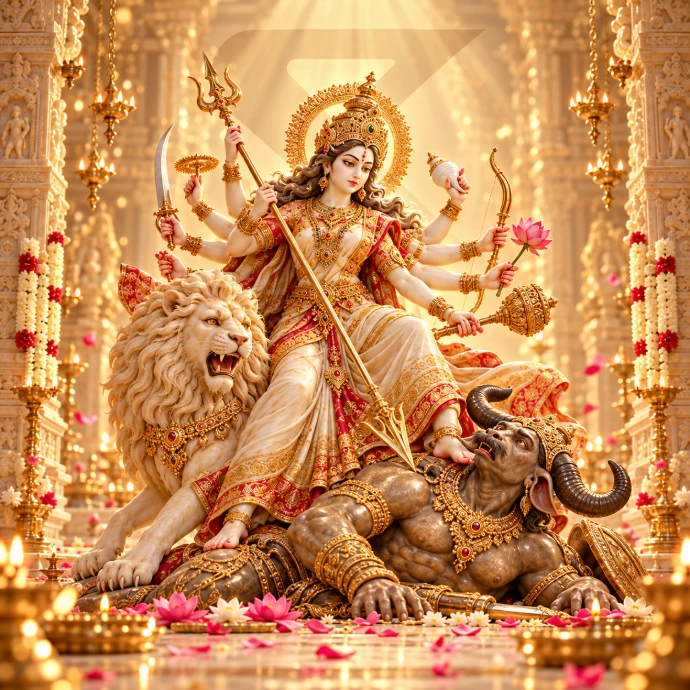
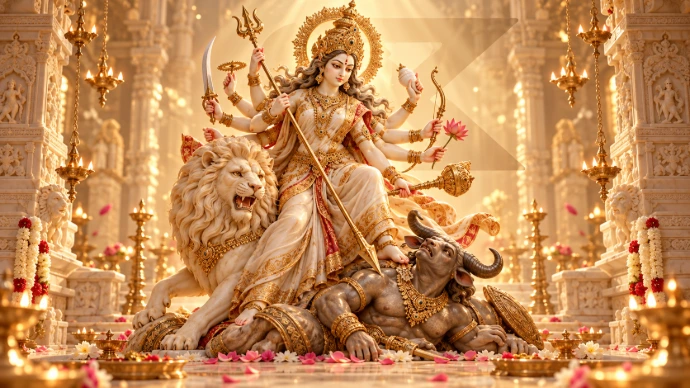
The Devi Mahatmya describes the Goddess attacking Mahishasura as he assumed different forms. At the climactic moment, she leapt upon him, pressed him down with her foot and struck him as he emerged from his buffalo form. She then severed his head with her sword.
The demon fell.
Mahishasura had been defeated.
The gods, who had once been driven from heaven, were freed from the terror that had overwhelmed them. They praised the Goddess and celebrated her victory.
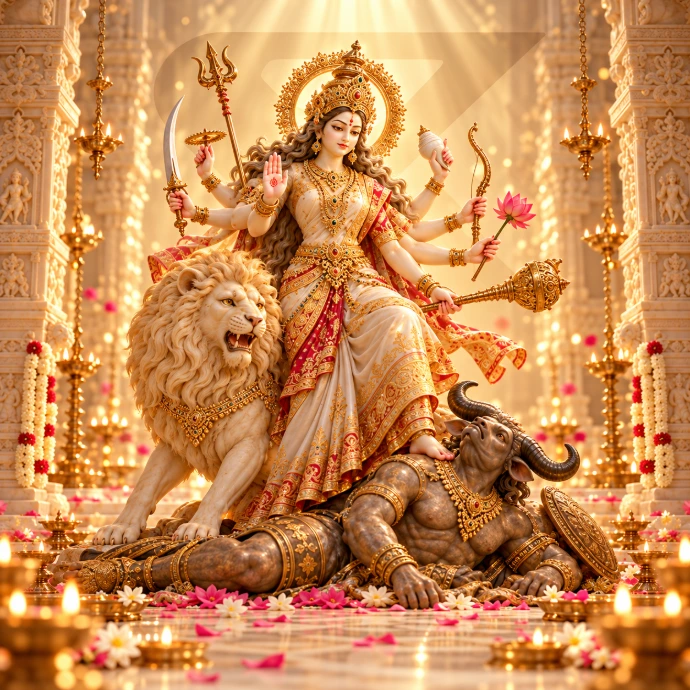
This is the moment represented by the celebrated image of Mahishasura Mardini.
In sculpture and visual art, the Goddess is often shown standing or advancing upon the buffalo demon, surrounded by her weapons and accompanied by her lion. The trident, sword and other divine weapons become part of an iconographic language that tells the story even without words.
The image is therefore not merely one of battle.
It is an image of Shakti overcoming oppression and restoring balance.
The Significance of the Story of Durga and Mahishasura
The Mahishasura story carries several layers of meaning.
At its most familiar level, it represents the victory of dharma over adharma, and of divine order over destructive power. But the story also carries a profound understanding of Shakti.
The gods possess immense powers, yet they cannot defeat Mahishasura individually. Their energies come together and manifest as the Goddess. In this sense, Durga embodies a divine power that is both collective and supreme.
She is fierce in battle, but she is not portrayed as driven by cruelty. Her violence is directed towards restoring balance.
This combination of power and compassion is central to the Goddess's character. After the defeat of the asuras, the gods praise her not only for her strength but for the protection she has given to the worlds.
Mahishasura Mardini: The Form That Became an Icon
Few forms of Goddess Durga are as visually powerful as Mahishasura Mardini.
The Sanskrit expression Mahishasura Mardini means "the one who destroys or subdues Mahishasura." In this form, Durga is commonly depicted with multiple arms holding divine weapons, her lion beside or beneath her, and Mahishasura shown in his buffalo or emerging human form.
The image has inspired generations of Indian sculptors.
In some sculptures, Durga's face remains remarkably serene even while the battlefield unfolds around her. This contrast is significant: her power does not arise from uncontrolled anger but from divine purpose.
Her many arms also allow the sculpture to communicate the idea of many divine powers operating through one Goddess.
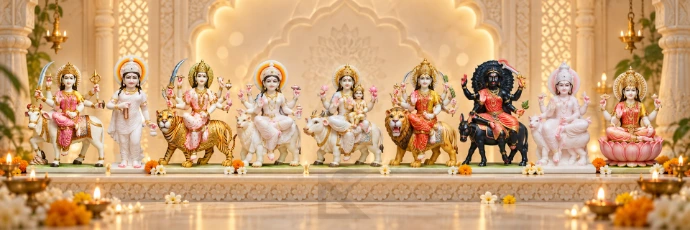
Traditional iconographic representations of Durga vary considerably across regions and artistic traditions. Academic studies of Indian sculpture note multiple weapon combinations and forms, illustrating why a single modern depiction should not be treated as the only legitimate representation.
Bringing the Legend of Durga Home
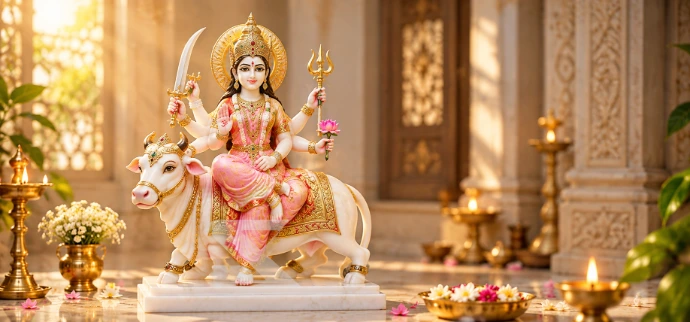
For many devotees, a Durga Mata or Mahishasura Mardini murti is more than an image placed inside a prayer room. It can become a visual reminder of courage, protection, Shakti and the triumph of dharma.
A carefully crafted sculpture allows the story to be experienced through form: the raised weapons, the lion, the defeated Mahishasura and the composed expression of the Goddess together narrate an ancient sacred story.
For a home mandir, a handcrafted marble Durga can also bring together India's long tradition of devotional sculpture with the permanence of natural stone.
Frequently Asked Questions
Goddess Durga, also called Chandika or Ambika in the Devi Mahatmya, defeats and kills Mahishasura. In the text's climactic account, she subdues him as he emerges from his buffalo form and cuts off his head with her sword.
The gods were unable to defeat Mahishasura, who had conquered them and taken control of heaven. Their combined divine energies (tejas) manifested as the Goddess, who received their weapons and went forth to defeat him.
Mahishasura Mardini means "the slayer" or "subduer of Mahishasura". It is one of the most recognisable forms and epithets of Goddess Durga, particularly associated with her victory over the buffalo demon.
The association of the Mahishasura battle with the nine nights of Navratri is deeply established in Hindu devotional tradition. However, the Devi Mahatmya narrative itself does not present the entire battle as a simple nine-day chronology. It is therefore more accurate to say that Navratri traditionally commemorates the Goddess's victory through nine nights of Devi worship.
Navratri celebrates the Goddess in her many manifestations, and the victory of Durga over Mahishasura is one of its central sacred narratives. The festival culminates in Vijayadashami, symbolising victory and the restoration of dharma.
With a craftsmanship heritage dating to 1971, its marble sculptures are created with attention to the visual details that give each divine form its identity. A Mahishasura Mardini sculpture requires particular attention to composition. Durga's posture, the placement of her weapons, the lion and the depiction of Mahishasura must come together as one balanced sculptural narrative.
Shilakrut's handcrafted marble designs bring these elements together while allowing the natural character of marble to remain part of the finished work. Those seeking to bring the story of the Goddess into a home, temple or sacred space can explore the Mahishasura Mardini Marble Statue collection, alongside other forms of Marble Durga Mata.
The story of Durga and Mahishasura has survived for centuries because its meaning extends beyond the battlefield.
Mahishasura represents power without balance. Durga represents Shakti guided by dharma.
Every year, when devotees invoke the Goddess during Navratri, the ancient story becomes present again — not simply as a tale of a demon defeated, but as a reminder that courage, divine power and righteous action can restore balance.
And in the serene yet powerful face of Mahishasura Mardini, Indian sculpture continues to preserve that story in stone.